 Wegovy semaglutide injection pens. Credit: K KStock/Adobe Stock
Last year, GLP-1s dominated many employer conversations as demand surged and pressure mounted from employees clamoring for the wonder drugs. Today, the pressure on employers to cover them is intensifying, and I believe it will continue to as oral GLP-1 medications likely enter the market as early as next year. As the landscape evolves, I believe the discussion will rapidly shift from scarcity to waste, as some employees and their employers do not get the full health benefits of these drugs. Understandably, employers are still weighing the cost impact of GLP-1 coverage, and some, after seeing the financial burden, have taken an abrupt turn and canceled coverage altogether. These stories are legendary in CHRO circles, but a new challenge is slowly emerging — oral GLP-1 medications for weight loss may help alleviate supply issues while creating new challenges of their own.
I believe when oral GLP-1s for obesity become available, we will likely see two major changes:
A highly anticipated decrease in cost.
I expect oral GLP-1s for weight loss will be priced significantly below injectables because pills are typically much less expensive to manufacture at scale than the current injectable formulation. Pharma hasn’t seen the level of coverage they’re accustomed to, which means billions in sales left on the table. They acknowledge employers’ financial burden covering injectable GLP-1s, and a significantly more affordable and easier-to-administer version could motivate more employers to provide coverage.
Recent outcomes data from Eli Lilly and Company on its new oral GLP-1 look promising — as do early results for the drug on weight management in patients with and without diabetes. Their CEO announced a half-billion-dollar stockpiling plan in anticipation of FDA approval, which is expected in 2026. This is likely a preventative measure to avoid the same shortages we saw with injectables that opened the door to widespread compounding. While this may feel like light years away, employers need to be thinking about how they’re going to prevent waste in both medication and dollars.
But here’s the rub. Does a lower price point really make good health care financial sense for employers? I’d argue that, at a lower price point, pill versions will be less expensive on a unit cost (per user) level. This is where, however, the cost debate shifts from sticker price to waste. I believe there is a clear segmentation between patients who may need to stay on GLP-1s for a longer period of time and those who intend to go off GLP-1s and seek alternative support. If the former goes off GLP-1s too early or the latter doesn’t get the support they need, they may gain much of the weight back.
Moreover, because oral medications can carry less of a hefty investment and commitment for members, patients may be less motivated to be consistent. Then, the likelihood of “yo-yo” usage could increase, where patients try it for six months, stop taking it, gain the weight back, and try again for another six months. If patients never experience the clinical benefits from GLP-1s, what’s the point of paying for them in the first place?
I believe that medication persistence and lifestyle changes – supported by companion programs that deliver on these – will be critical for patients to truly see meaningful, long-lasting outcomes. Otherwise, when we look at our overall expenditure, we may not see as much of a difference or savings from oral GLP-1s as one would expect.
Low medication persistence and adherence have an immense impact on wasted dollars. During the first year of GLP-1 use for weight loss, for example, studies show that two-thirds of commercially insured members were nonpersistent (more than a 60-day gap), and only 27% were adherent. There may be several reasons for this including cost, access, side effects and so on. Estimates suggest that nonadherence to medications broadly has been attributed to between $100-$300 billion in avoidable health care costs. And the weight gain seen in clinical trials after patients stop taking GLP-1s has real consequences. For example, if they don’t have support around lifestyle behavior change, these patients are less likely to maintain the health benefits that can occur with weight loss, including reduced risks of heart disease, diabetes, and metabolic liver disease.
The second shift we should expect to see is how doctors and patients will strategically use both oral GLP-1 versions and injectable medications.
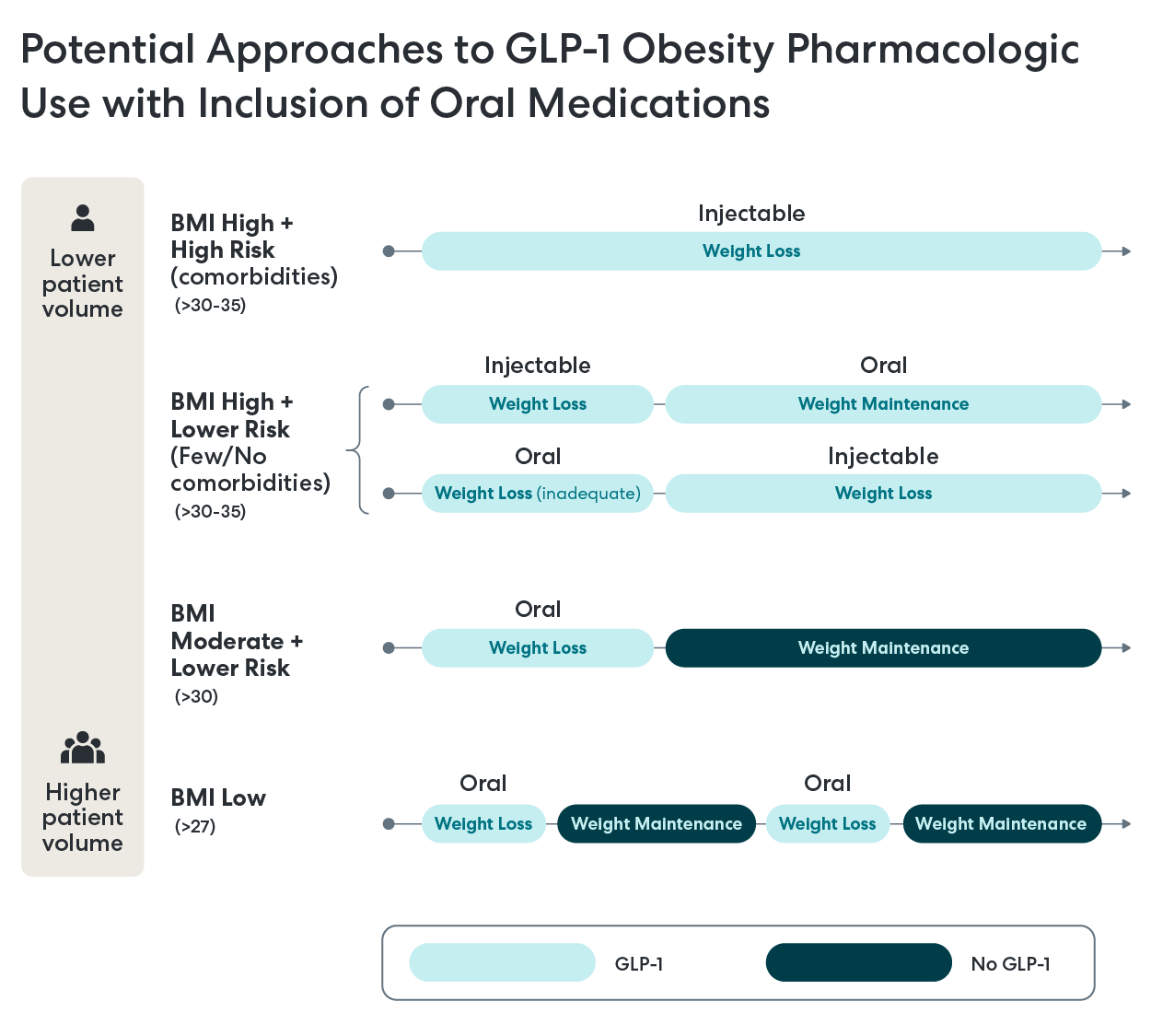
If oral GLP-1s are covered by employers, it doesn’t mean that injectable GLP-1s go away. I believe we may see a step up and step down therapy, an approach currently being studied by Eli Lilly, that pairs injectables and oral medications to treat obesity – especially as oral versions begin to demonstrate similar efficacy and safety to injectables. A patient may use an injectable version to jump start their weight loss. When a weight goal has been achieved, the prescribing physician could then transition the patient to oral medications, given the lower price point, for maintenance. Alternatively, an individual could also start with oral medication for cost reasons, and if desired results weren’t achieved, a provider could transition them to an injectable GLP-1.
Oral GLP-1s and the potential rise of inconsistent adherence and resulting waste could be the Trojan Horse that leads employers and payers to provide broader coverage and more generalized access to GLP-1s regardless of the formulation. Here’s how this could shake out:
Potential approaches to GLP-1 obesity pharmacologic use with inclusion of oral medications
Given the potential changes in how various GLP-1 medications are priced and prescribed, I believe it’s more important than ever for employers to take intentional steps to support demand for these drugs and help sustain the health benefits they provide.
While some members taking GLP-1s will need them for life, most will not need to nor want to be on lifelong medication due to the expense, the desire to be free of an injection or pill, or they’ve simply achieved their goal weight and want to manage it on their own. And when they do stop the medication (oral or injectable), for most people, the food cravings will likely come back, the habits may not stick, and the weight could return, bringing members and employers back to square one. This full circle moment could waste not only money but critical time that could lead to worsening conditions and co-morbidities which cost them more in the long run. Only this time, multiply these consequences several-fold as more people use GLP-1s due to the price decrease.
It doesn’t have to be this way. If we’re going to cover these medications, we can do it right.
Achieving and maintaining weight loss and better health is a long game. I believe the antidote is for employers to provide lifestyle intervention programs alongside the medication. These programs actively support members establishing healthy habits and routines, which include medication adherence – well before someone decides to stop their GLP-1.
With the emergence of GLP-1s, many employers have turned to their pharmacy benefit managers (PBMs) for support. Programs like Cigna’s Express Scripts Encircle Rx, CVS Caremark’s Weight Management Program, and Optum Rx‘s Weight Engage aim to help employers in providing GLP-1 access to employees who truly need them, in a financially responsible way.
Pharmacy benefit managers will almost certainly expand in this space. A 2024 Business Group on Health (BGH) survey found that 96% of employers were concerned about the long-term cost implications of newer weight management drugs like GLP-1s. Pharmacy benefit managers are in a prime position to help expand access to GLP-1s, and I have proposed a framework as to how this could be done at scale. Programs like this – in which pharmaceutical companies, employers, and PBMs cooperate for patients’ benefit – may become even more essential for employer benefits strategies as oral medications come to market, in order to ensure patients are establishing healthy food choices, as well as engaging in exercise and muscle health. Lifestyle interventions — through support from your PBM or otherwise— have real potential to deliver increased and sustained weight loss.
We must reflect on the enormity of our nation’s obesity health crisis, where GLP-1s have proven to be incredibly effective. GLP-1s are not the problem, and, indeed, we need to view them in all their formulations as part of the solution. According to the WHO, obesity is a primary condition that leads to secondary conditions like diabetes, high blood pressure, musculoskeletal issues, and countless other diseases. The health care costs of these complications are profound, as is their impact on our employees, friends, and loved ones. Obesity is a dilemma for humanity, but we’re on the way to solving it – as long as we don’t waste our good intentions with disjointed commitments.
If we work together to provide access to GLP-1s with the kind of lifestyle support that’s needed, we can bend the curve on obesity. Isn’t that a legacy we’d all be proud of?
© Arc, All Rights Reserved. Request academic re-use from www.copyright.com. All other uses, submit a request to TMSalesOperations@arc-network.com. For more information visit Asset & Logo Licensing.