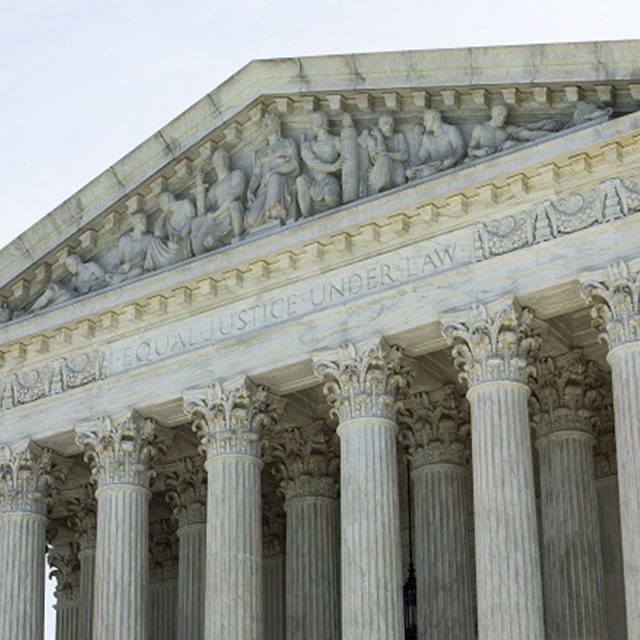
 A detail from the pediment of the U.S. Supreme Court building in Washington. Credit: Diego M. Radzinschi/ALM
The U.S. Supreme Court is looking at a case that could determine the fate of one type of health care payment arrangement that falls outside the scope of the Affordable Care Act major medical insurance requirements: the health care cost-sharing ministry.
To a layperson, the case may look as if it could end up affecting, directly or indirectly, how the federal courts handle many products that fall outside the scope of the ACA major medical insurance requirements, such as short-term health insurance and hospital indemnity insurance.
William Schiffbauer, a lawyer who has been working on federal health insurance legal issues for years, says any suggestion that the health care cost-sharing ministry case, Renteria v. New Mexico Office of the Superintendent of Insurance, could affect the class of "non-ACA" products known as "excepted benefits" "sails way, way off course."
"Excepted benefits are 'excepted' because they are not comprehensive major medical insurance," Schiffbauer said via email. "Excepted benefits are not mentioned at all in the initial complaint to the federal district court, nor in the federal district court's opinion, nor in the appeal to the 10th Circuit, nor in the 10th Circuit's opinion, nor in the petition for certiorari to the Supreme Court, nor in the amicus brief filed by the Health Sharing Ministries Alliance, nor in the New Mexico superintendent of insurance's brief, nor in the petitioner's brief."
Schiffbauer added that the idea of referring to excepted benefits in an article about the Renteria case is "a mystery akin to the Bermuda Triangle."
What it means: Schiffbauer says the takeaway is that the "health sharing ministry case will not impact 'excepted benefits' at all."
Schiffbauer's views have weight, because he was one of the first people to point out that the Internal Revenue Service would enforce ACA coverage ownership provisions, by imposing "shared responsibility" penalties on individuals who failed to own what the ACA classified as "minimum essential coverage" and on employers that failed to provide minimum essential coverage.
He has also played a leading rule in efforts to keep the federal government from imposing burdensome rules on providers of non-ACA insurance products.
Affordable Care Act major medical insurance rules: The ACA drafters applied many rules to individual and small-group major medical insurance policies, including rules that the policies cover a minimum percentage of the value of a standard "essential health benefits" package, that they sell and price coverage without subjecting the applicants to medical underwriting, and that they cover essential health benefits without imposing annual or lifetime limits on the coverage.
Drafters exempted some types of arrangements from the major medical insurance requirements.
One exemption is for the products classified as "excepted benefits" for purposes of the federal Health Insurance Portability and Accountability Act, such as dental insurance, vision insurance, critical illness insurance and fixed indemnity insurance.
Other, nearby provisions exempt arrangements such as health care cost-sharing ministries, and the Internal Revenue Service has classified products such as short-term health insurance and travel medical insurance as being exempt.
The ACA does not mention direct primary care arrangements, or arrangements that let people pay membership fees to get access to primary care for a set amount of time. In the future, it's possible that Congress or federal regulators could treat direct primary care arrangements as non-ACA arrangements in their own right. For now, the Internal Revenue Service has focused on talking about the kinds of arrangements taxpayers can use to pay for direct primary care memberships. Congress recently included a provision letting people using health savings account cash to pay direct primary care dues in the One Big Beautiful Bill Act.
Health care cost-sharing ministries: Health care cost-sharing ministries are arrangements that let people with shared religious values join together to pay for each other's care.
The Renteria case: The New Mexico insurance superintendent tried to make the Gospel Light Mennonite Church Medical Aid Plan, a health care cost-sharing ministry, comply with state health insurance laws.
The ministry argued that many of the state's proposed requirements would conflict with its principles and could conflict with federal health care cost-sharing ministry rules in ways that could effectively shut it down.
Two women in New Mexico, Breanna Renteria and Laura Smith, sued in state court to try to get access to the Gospel Light Mennonite plan. Since then, they have been filing appeals in state court and federal court to make their case.
So far, the U.S. Supreme Court has not formally agreed to take up the case by "granting certiorari," but it has distributed the case for conference twice, and it has asked the solicitor general of the United States — the top lawyer for the administration of President Donald Trump — to weigh in.
Health care cost-sharing ministries vs. other non-ACA arrangements: The plaintiffs in the Renteria case do not talk about excepted benefits, but they do argue that New Mexico regulators have been tougher on health care cost-sharing ministries than on comparable secular organizations, such as health care sharing plans set up by labor unions and fraternal organizations.
Like a health care cost-sharing ministry plan, a short-term health insurance policy is an example of a product that has been exempted from the ACA major medical insurance requirements and is not classified as an excepted benefit.
Unlike a health care cost-sharing ministry plan, a short-term health insurance is a state-regulated insurance product. A state can choose to let insurers use medical underwriting when selling the product and provide relatively limited benefits.
Some states have tried to impose tough rules on issuers of short-term health insurance or ban sales of the product, because of concerns that competition from a cheaper, leaner, medically underwritten product could destabilize the major medical insurance market.
Could a lawsuit parties or courts somehow use the reasoning in any Supreme Court ruling on the Renteria case in cases involving products like short-term health insurance?
Schiffbauer emphasizes that the legal issues involving short-term health insurance and health care cost-sharing ministries are completely different.
"Health care sharing ministries are not 'insurance' and so not regulated by the states," Schiffbauer says. "The Renteria case only implicates health care sharing ministry coverage."
© Arc, All Rights Reserved. Request academic re-use from www.copyright.com. All other uses, submit a request to TMSalesOperations@arc-network.com. For more information visit Asset & Logo Licensing.