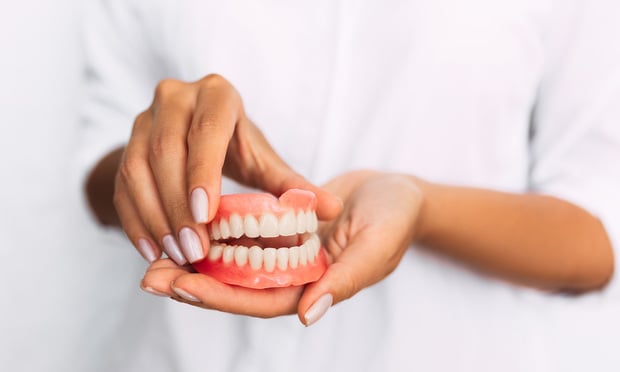
 The dentist is holding dentures in his hands.
Studies show that the potential high cost of dental care remains a major concern and barrier to routine oral care for U.S. adults. Even with employer-sponsored dental insurance, financially strained employees may delay or skip regular dental care, leading to more severe and costly oral health issues later. Persistent inflation has steepened this barrier, with dental costs rising by 30% in the last 20 years, with increased rate of change following the COVID pandemic. However, most dental plan designs have remained unchanged, leaving employees to shoulder the burden.
Rising financial barriers to dental care are costing employers, too. As oral health is deeply connected to holistic wellbeing, when dental problems go untreated, this slows down employee attendance, engagement and productivity, and impacts business outcomes. This article discusses how employers can enhance their benefits programs with an emphasis on preventive care to address the limitations of traditional dental plans, reduce financial barriers for employees, and enhance workplace outcomes.
Promoting oral health is good for business
Oral health and business outcomes are indisputably linked. The American Dental Association finds over 164 million work hours are lost annually in the U.S. due to oral health issues, equating to 1.48 hours per person or about 16% of the population missing work. The CareQuest Institute for Oral Health estimates even higher losses, with over 243 million hours of work or school missed each year, costing around $45 billion in lost productivity, including over 34 million hours due to unplanned dental care like emergency room visits.
Ultimately, addressing barriers to dental care for employees and encouraging them to prioritize their oral health supports business outcomes. Considering rising costs, employers have a timely opportunity and obligation to reevaluate their dental plans and consider enhancements that can help make preventive care more affordable and accessible. A promising approach to achieving these goals is the adoption of value-based principals in employer-offered dental benefits programs.
Benefits of preventive dental care
Value-based care is a form of health care that aligns incentives for payors and providers by focusing on preventing and detecting health issues early, rather than treating them after they develop. Emphasizing prevention, value-based care encourages smarter, proactive treatment that helps patients stay healthy and avoid costly interventions later on, saving them time, money and stress long-term.
In dentistry, preventive care includes regular cleanings, X-rays, and sealants for children. Costs associated with preventive measures such as these are generally a fraction of what one might spend treating more serious conditions that arise from neglect, even when patients are covered by insurance. For instance, on average, filling a cavity might cost an insured individual around $108 with $33 in out-of-pocket costs, whereas an untreated cavity that results in a root canal and crown could potentially cost $1,750 with out-of-pocket costs typically around $925, according to MetLife data[1].
In essence, programs with value-based components help shift the exchange of value to focus more on patient outcomes than on payment for services rendered—helping to reduce costs and improve patients’ holistic health.
In a similar way, value-based programs can help promote detection of broader health issues early, potentially reducing overall medical costs. Dentists often spot symptoms of conditions like diabetes, cardiovascular disease, and chronic stress. For example, Harvard Medical School research finds people with gum (periodontal) disease have two to three times the risk of having a heart attack, stroke, or other serious cardiovascular event. Early detection through preventive care empowers patients to take a proactive stance, improving their health and reducing overall expenditures.
Embracing value-based models
While medical plans and government-sponsored dental programs have embraced value-based elements for years, employer-provided dental plans have been slow to adopt them, despite their clear financial and health advantages. Even amidst rising inflation, most employer-sponsored dental plans have remained unchanged and aren’t keeping up with the true cost of care for patients. This also exacerbates another related barrier to dental care in accessing affordable dentists, which is inconsistent across the country, particularly in rural areas.
While plan designs can take time to restructure, employers can begin by integrating programs that emphasize value-based dental principals as a critical step in supporting their employees’ overall wellness. MetLife’s SpotLite on Oral Health program, for example, helps employees connect with general and pediatric dentists participating in the Preferred Dentist Program who have shown a strong commitment to improved oral health outcomes through a proprietary evaluation process and simplified digital experience.
While many employer-sponsored plans offer carrier networks that are designed to help offset financial barriers through negotiated discounts, employers should also look to determine whether their plans have the right providers to balance network access and depth of discount. Programs like SpotLite that help identify in-network dentists with a focus on preventive care can help reduce the total out of pocket costs over the patient’s lifetime. According to MetLife’s data, patients who used SpotLite-certified providers experienced an average of 17% lower costs compared to standard in-network dentists and 41% lower costs compared to out-of-network care.
Driving engagement through benefits communication
In addition to embracing value-based care, employers should also clearly communicate the benefits of these programs to employees and guide them on how to use their benefits to take full advantage. Over half (52%) of employees do not fully understand their benefits package, according to MetLife’s latest research, which can lead to confusion and underutilization. Developing benefits communication strategies that are educational and supportive can help address this ‘confusion gap’ and promote better engagement.
MetLife’s study also found that 43% of employees say the benefits communications they receive are not relevant to them, which means communications around benefits can be more tailored to better reach and resonate with employee groups. For example, Gen Z employees may prefer to receive short-form communications akin to social media posts and in digital or video formats.
Conclusion
Addressing the rising costs of dental care through value-based dental programs not only improves employee health but also enhances workplace productivity. By prioritizing preventive measures, employers foster a culture of wellbeing that benefits everyone.
Ultimately, when employees smile more, work feels better, and organizations thrive.
Chris Swanker, Senior Vice President, leads MetLife’s Group Supplemental Health Products, including Dental, Accident, Critical Illness and Hospital Indemnity insurance offerings, where he oversees product strategy, network development, and delivery of the customer experience, as well as oversight for Group Benefits Contracts and Compliance. Chris has over 25 years of experience leading group benefits businesses and developing strategies to expand into new markets and capabilities. He holds a B.S. in Mathematics from Mansfield University of Pennsylvania, is a Fellow in the Society of Actuaries (FSA), and is an active member of the American Academy of Actuaries (MAAA) and the National Board of Directors of the Dental Lifeline Network.
© Arc, All Rights Reserved. Request academic re-use from www.copyright.com. All other uses, submit a request to TMSalesOperations@arc-network.com. For more information visit Asset & Logo Licensing.