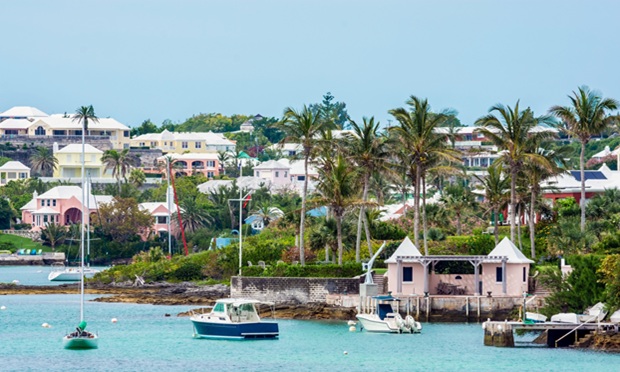
 Hamilton, Bermuda.
Employers and their benefits advisors often work with firms with operations, affiliates or service providers based in Bermuda.
A new ruling by a three-judge panel at the 4th U.S. Circuit Court of Appeals could affect what happens when the U.S. benefit plan sponsors or advisors and the Bermuda-linked firms take disputes to arbitration in Bermuda.
Federal courts have to start by paying close attention to the citizenship of all of the entities involved in the dispute, according to a published opinion on the health benefits arbitration case, Employers' Innovative Network et al. v. Bridgeport Benefits et al., that was written by Chief Circuit Judge Albert Diaz.
Related: UnitedHealthcare faces more federal court litigation over T-Mobile plan hernia repair claim denial
The 4th Circuit panel overturned a district court ruling in favor of Bridgeport Benefits and the other defendants and asked the district court to get more information about the official corporate home of one of the parties and how the relationships between the parties involve property, performance or "some other reasonable relation" with "one or more foreign states."
What it means: Future pleadings in the Employers' Innovative Network case could show employers and benefits advisors how the federal courts will handle disputes over arbitration when at least one of the parties is, or might be, based in Bermuda.
Case details: Employers' Innovative Network, a professional employer organization based in West Virginia, tried to work with Bridgeport Benefits and other people and entities to set up a health plan for the PEO.
The PEO and the health benefits providers ended up clashing. Employees' Innovative Network and Jeff Mullins, the PEO's chief executive officer, sued Bridgeport Benefits, Capital Security and other individuals and entities in the U.S. District Court for the Southern District of West Virginia in 2018.
The parties agreed to take the case to arbitration in Bermuda.
The arbitration was governed by the Federal Arbitration Act and the New York Convention, an international treaty on arbitration.
Capital Security "initially told the district court that its principal place of business was in Florida" and "later represented that its principal place of business was in Bermuda and acknowledged the discrepancy in its filings," according to the Diaz opinion.
The arbitrator in Bermuda ruled against the PEO and for the defendants. The defendants asked a federal district court to enforce the Bermuda arbitration award.
The PEO and Mullins said that they had found evidence that the arbitrator was biased, and they said that a U.S. court enforcing the arbitration ruling would violate a provision in the New York Convention that prohibits the U.S. courts from enforcing non-U.S. arbitration awards that go against the public policy of the United States.
The district court ruled for the defendants.
The PEO and Mullins asked the 4th Circuit to reverse the district court ruling.
The 4th Circuit panel declined to take a position on whether the U.S. courts should enforce the Bermuda arbitration ruling.
Instead, the 4th Circuit panel asked the district court to get more information, to determine how to apply the provisions in the New York Convention that may protect U.S. parties from enforcement of some non-U.S. arbitration rulings.
Kenneth Carr, an attorney for Employers' Innovative Network, declined to comment on the ruling.
Representatives for Bridgeport and the other defendants could not immediately be reached for comment.
© Arc, All Rights Reserved. Request academic re-use from www.copyright.com. All other uses, submit a request to TMSalesOperations@arc-network.com. For more information visit Asset & Logo Licensing.