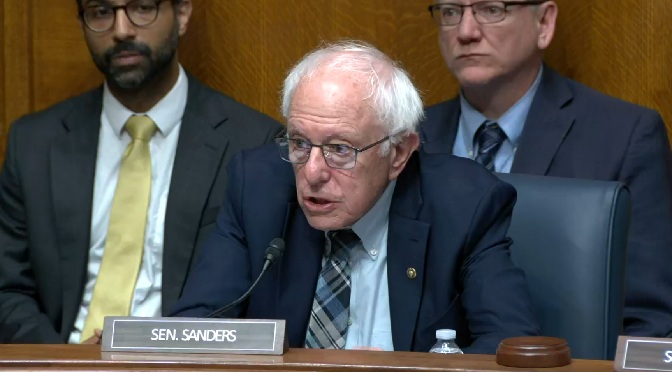
 Sen. Bernie Sanders speaking at a Senate HELP hearing on health care costs. Credit: Senate HELP
Sen. Bernie Sanders last week attacked the idea of big health insurers owning health care providers.
Sanders — an independent from Vermont who allies himself with the Democrats in the Senate for many purposes — talked about "vertical integration" of health insurers and health care providers during a hearing on health care costs organized by the Senate Health, Education, Labor and Pensions Committee.
One of the hearing witnesses, Wendell Potter, got his start as a Cigna communications manager. He left Cigna to become a prominent critic of health insurers.
Sanders noted that a recent Potter report shows that UnitedHealth has acquired about 2,700 health care companies.
"It sounds to me like we're moving to a single-payer system run by UnitedHealth for their own financial advantage," Sanders told Potter.
Health insurers are buying health care providers because the Affordable Care Act minimum medical loss ratio provision requires health insurers to spend 80% of individual and small-group revenue and 85% of large-group revenue on health care and health care quality improvement, but the ACA sets no such revenue spending requirements for health care providers.
Related: Consider breaking up UnitedHealth, Senator Warren tells DOGE head Elon Musk
"They've been in the doghouse for quite some time now," Potter said. "On their earnings call this past week, they said that, to get back into Wall Street's good graces, they are going to be narrowing their networks. They're going to be raising premiums by double digits. And they're going to be cutting benefits across the board."
Competition: Sen. Bill Cassidy, R-La., the chairman of the committee, asked Potter why customers don't go with competitors instead of sticking with insurers that use vertical integration to pad margins.
"I think it's because, first of all, there's not a lot of competition," Potter said.
Most big health insurers take a similar approach, Potter said.
The Senate HELP Committee had no health insurance company executives or witnesses sympathetic to the concerns of health plans on the panel. The more moderate and conservative witnesses at the hearing focused more on concerns about health insurer and health plan administrator data transparency than on vertical integration.
A benefit consultant's perspective: Chris Deacon, principal and founder of VerSan Consulting of Moorestown, New Jersey, talked about the difficulty employers with self-funded health plans have with getting pharmacy benefit managers and other vendors to provide pricing data and detailed claim data.
A new transparency law that was enacted in 2021 was supposed to help employers get hospital and physician pricing data, but "the files are a mess," Deacon said. "Even the most sophisticated firms can't use the data without a major effort."
When employers ask their own vendors for plan claim data, "they're denied access," Deacon said. "Employers pay the bills. They take on the financial risk, and they are expected to manage the plan. Yet, they still can't see what they're paying for. Employers are told to manage costs, but they're not allowed to see costs."
© Arc, All Rights Reserved. Request academic re-use from www.copyright.com. All other uses, submit a request to TMSalesOperations@arc-network.com. For more information visit Asset & Logo Licensing.