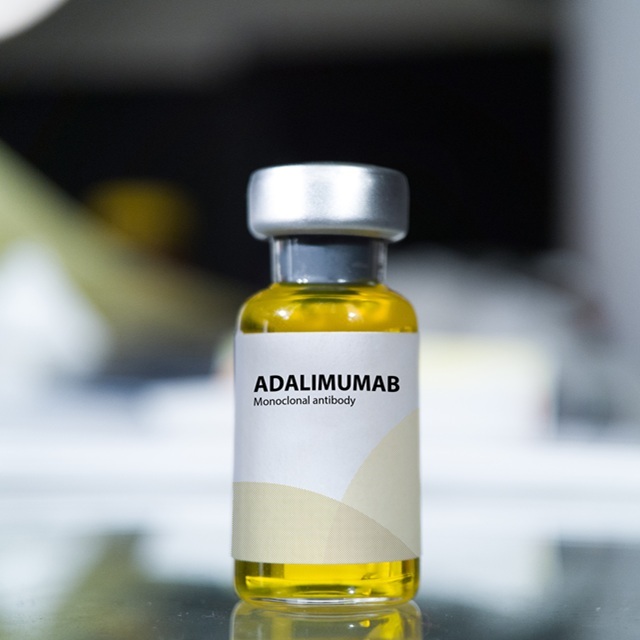
 A vial of adalimumab, a monoclonal antibody that's a biosimilar equivalent to Humira. Credit: Soni's/Adobe Stock
The U.S. health care system has a remarkable track record of creating breakthrough medicines and treatments. But that same innovation has fueled unsustainable costs, including for specialty biologics like Humira and Stelara, which can cost up to $80,000 annually.
Rising drug prices have prompted health plans and employer-sponsored benefit programs to look at pharmacy benefit manager practices more closely.
Overall health care costs are projected to increase by 8% in 2025 and another 9% in 2026, driven in part by growing utilization of high-cost medications like biologics and GLP-1 therapies.
While GLP-1s remain under patent protection, many biologics now have FDA-approved biosimilar alternatives priced closer to $15,000 annually.
The biosimilar alternatives offer potential savings and greater access.
Employer health plans can turn the cost and access tide by ensuring that patients managing complex conditions like rheumatoid and psoriatic arthritis, ulcerative colitis and Crohn's disease can get the medications they need at the lowest price possible.
For employers and benefits advisors, the challenge is building confidence in biosimilars and driving change in established practices to unlock savings without sacrificing outcomes.
Biologics vs. Biosimilars
Biologics like Humira (adalimumab) and Stelara (ustekinumab) are disease-modifying antirheumatic drugs (DMARDs) made from monoclonal antibodies.
Unlike traditional pills, they are grown from living organisms, must be refrigerated, and often are managed by specialty pharmacies.
Complex? Yes.
Worth $80,000 a year? Not when we have clinically equivalent biosimilars for a fraction of the price.
The FDA has cleared 10 adalimumab biosimilars and seven ustekinumab biosimilars to treat diseases including rheumatoid arthritis, psoriatic arthritis, Crohn's disease, ulcerative colitis and plaque psoriasis.
The market is expanding, but patent litigation and evolving interchangeability standards have delayed broader adoption.
Why traditional PBMs slowed adoption
Spread-based PBM models profit from complexity and create margin between acquisition and billing.
PBM rebate retention also encourages formulary placement of high-price/high-rebate brand drugs over low-cost/low-rebate biosimilars.
While some patients may see the same $50 copay either way, their employer plan sponsors don't have much visibility into the underlying costs.
Employers could be paying four times as much.
The transparency shift
Recent trends — including rising drug costs, greater brand utilization, and expanded access to generics and biosimilars — have prompted entities across the supply chain to reevaluate traditional approaches and introduce alternative models to access and affordability:
♦ CVS CostVantage pricing ties pharmacy reimbursement to reference drug costs plus a fee for services provided.
♦ CivicaScript, a nonprofit founded by 25-plus health plans and PBMs, including Navitus, manufactures affordable generics with drug pricing accessible from the product label.
♦ Direct-to-consumer pharmacy platforms like LillyDirect and NovoCare simplify access to high-cost drugs by offering transparent, upfront cash prices directly to the patients.
Putting transparency to work
One player in the pharmacy benefits market, Lumicera Health Services, addressed the specialty drug market with a unique acquisition-cost-plus strategy, based on a patient-management-fee model, more than 10 years ago.
The company has recently worked directly with biosimilar makers to get product access.
Earlier this year, Lumicera expanded its partnership with Costco Pharmacy to bring cost-plus specialty pharmacy services to even more patients across the United States.
The PBM at Navitus Health Solutions, where I work, promoted use of biosimilars in June 2024 by removing Humira from the formulary in favor of biosimilar alternatives. As a result, 97% of claims shifted to adalimumab biosimilars, cutting net cost per claim by 60% and saving $315 million upfront.
This summer, ustekinumab biosimilars were added to the formulary, and we expect to see plan savings of $120 million annually from this transition.
What's next?
True biosimilar adoption requires systemwide alignment.
Provider and patient education must expand to build confidence in these biosimilars.
Interchangeability standards must give pharmacists more substitution authority.
PBMs must show how formulary decisions lower total costs, not just maximize rebates.
For health plans and plan sponsors, the path forward is clear: demand transparency from your PBM, insist on biosimilar adoption, and make sure savings reach both the plan and the patient.
The sooner these changes take hold, the faster the industry can deliver affordable access to life-changing medicines.
Sharon Faust, Pharm.D., is the chief pharmacy officer at Navitus, a pharmacy benefit manager. She is a licensed pharmacist in Wisconsin and has a doctor of pharmacy degree. She serves on the board of the National Association of Specialty Pharmacy and the drug selection advisory committee at CivicaScript.
© Arc, All Rights Reserved. Request academic re-use from www.copyright.com. All other uses, submit a request to TMSalesOperations@arc-network.com. For more information visit Asset & Logo Licensing.