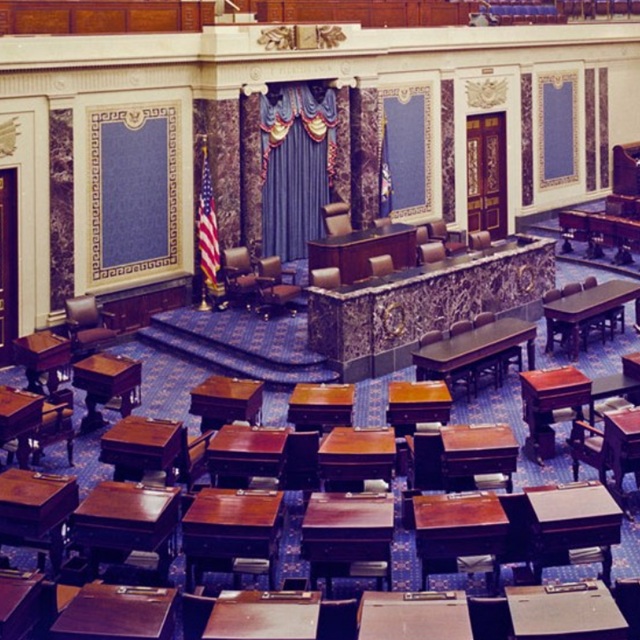
 The U.S. Senate Chamber. Credit: Architect of the Capitol
Members of the U.S. Senate came together Thursday to support employee stock ownership plans.
The chamber approved two ESOP bills by "unanimous consent" and sent them to the U.S. House.
One bill, introduced by Sen. Roger Marshall, R-Kan., would set a statutory definition of the term "adequate consideration" in connection with mergers, acquisitions and other transactions involving ESOPs.
Another bill, introduced by Sen. Bill Cassidy, R-La., would add two representatives from the ESOP community to the ERISA Advisory Council, a body that helps the U.S. Labor Department and the department's Employee Benefits Security Administration oversee matters related to the Employee Retirement Income Security Act.
The Senate uses a unanimous consent process to handle legislation that has no noteworthy opposition. Passage through the process means that no one on the Senate floor opposed approval of the bill.
Adequate consideration: ESOPs give the owner of a privately held company a way to put an ownership stake in the hands of employees.
ERISA requires benefit plan fiduciaries to make sure that parties involved with plan transactions provide "adequate consideration," but it and the Labor Department have not created a well-defined method for ESOP fiduciaries to value the ESOPs.
The bill passed by the Senate Thursday would let an ESOP fiduciary make a "good faith reliance" on "valuation provided by an independent valuation expert or business appraiser that has relied upon the principles and methodologies set forth in Internal Revenue Service Revenue Ruling 59–60 (as amplified and modified by the Internal Revenue Service from time to time)."
Ruling 59-60 sets out the standard IRS rules for valuing assets.
Provisions state that the bill would not expand or limit the Labor secretary's authority to interpret the term "adequate consideration" and would not change the fiduciary's obligations to the plan participants.
ERISA Advisory Council: The ERISA Advisory Council bill would add two members to the main council.
It would also create a seven-member Advisory Council on Employee Ownership.
All seven members would be appointed by the Labor secretary.
Four would represent employees, one would represent an ESOP sponsor, one would represent an ESOP provider and one would represent a group for ESOPs or for worker-owned cooperatives.
No more than four members of the council could be members of the same political party.
© Arc, All Rights Reserved. Request academic re-use from www.copyright.com. All other uses, submit a request to TMSalesOperations@arc-network.com. For more information visit Asset & Logo Licensing.