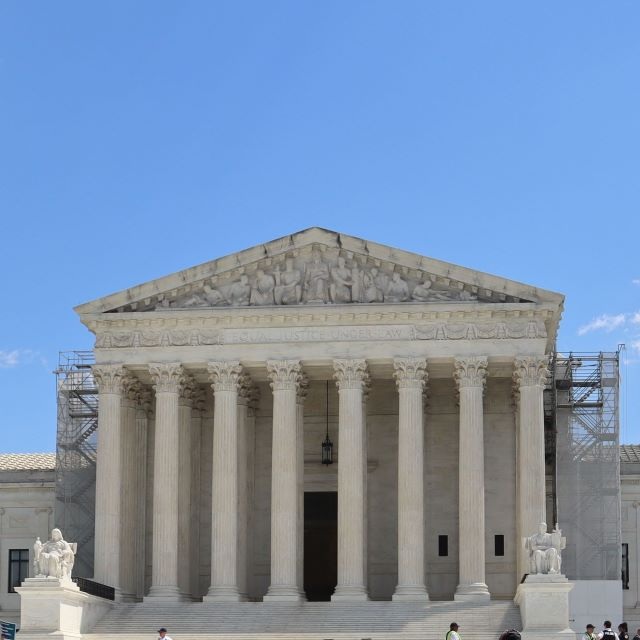
 The U.S. Supreme Court. Photo: Eden Jackson Landow/ALM
The U.S. Supreme Court is considering a case filed by two women in New Mexico who want Alice Kane, the state's insurance superintendent, to let them join the Gospel Light Mennonite Church Medical Aid Plan, a health care cost-sharing ministry.
The court showed its interest in the case Monday by asking the top lawyer for the administration of President Donald Trump, Solicitor General D. John Sauer, to file a brief expressing the views of the United States on the case.
A health care cost-sharing ministry is an organization that helps people who share spiritual beliefs pay for each other's care. Federal law lets ministries established in or after 1999 operate outside the Affordable Care Act rules that apply to providers of major medical insurance.
Kane ruled that the Gospel Light plan is a health insurance provider that violates state health insurance requirements. She has ordered the plan to register as a health insurer or stop operating in New Mexico.
The plaintiffs, Breanna Renteria and Laura Smith, say participating in the Gospel Light plan is a way for them to pay for health care without having to support an organization that covers birth control or other products or services that violate their religious beliefs.
The women want the Supreme Court to rule that the Gospel Light plan can operate in New Mexico.
Representatives for the plaintiffs in the case, Renteria v. New Mexico Office of the Superintendent of Insurance, and the New Mexico insurance superintendent could not immediately be reached for comment.
What it means for employers: The Renteria case involves apparent conflicts between state and federal rules for a health care funding arrangement that operates outside the jurisdiction of the Affordable Care Act major medical rules.
That means that, in theory, depending on what reasoning the Supreme Court uses if it rules on the case, and how lawsuit parties and courts try to apply any ruling that emerges, any ruling could end up affecting the rules for other "non-ACA" products, such as "excepted benefits" — a category that includes products like hospital indemnity insurance policies and dental health insurance policies. Any Renteria ruling could also affect other types of "non-ACA" arrangements, such as short-term health insurance policies and, possibly, products like direct primary care contracts.
The petition does not mention excepted benefits, but, in the PDF version of the Patient Protection and Affordable Care Act, or Public Law 111-148, the provision that describes the penalty exemption for taxpayers in health care cost-sharing ministries, Section 5000A(d)(2), is just three pages away from Section 5000A(e)(3), the provision that exempts excepted benefits from the ACA major medical insurance requirements.
The case could also end up affecting employers who want to use federal laws such as the federal Religious Freedom Restoration Act to avoid having to comply with certain federal health requirements, such as the Affordable Care Act preventive services requirements.
Affordable Care Act health care cost-sharing ministry rules: The federal Affordable Care Act and the ACA require individual major medical insurance, or policies that provide "minimum essential coverage," to meet many requirements, such as benefits standards and rules banning use of individual health information in efforts to sell and price health coverage.
The ACA "individual shared responsibility" section once required many people to show that they have individual major medical coverage or else pay a penalty. Congress set the ACA individual shared responsibility penalty at $0 in 2019.
When the penalty was greater than $0, the ACA let people use proof of having a health sharing ministry membership to avoid paying the penalty.
The Renteria case: Renteria and Smith have argued in their petition that, because of details in the Affordable Care Act and ACA regulations, such as a requirement that health care cost-sharing ministries offer memberships to residents of all states, letting the New Mexico effort to regulate Gospel Light stand could shut down all ACA health care cost-sharing ministries throughout the United States.
Renteria and Smith sued in New Mexico state in an effort to overturn the New Mexico superintendent's order.
When they lost, they asked the U.S. District Court for the District of New Mexico for an injunction blocking the order.
The district court judge rejected the request.
A three-judge panel at the 10th U.S. Circuit Court of Appeals ruled 2-1 in Kane's favor.
The plaintiffs filed a petition with the Supreme Court in July.
The Alliance of Health Care Sharing Ministries filed a brief supporting the plaintiffs in September.
The backdrop: The current members of the Supreme Court seem likely to have some sympathy for Renteria's and Smith's concerns about access to a health care finance arrangement that fits with their moral standards.
In recent years, the court has objected to government efforts to apply health coverage rules that conflict with residents' religious beliefs.
But the court has also backed Arkansas' effort to get around the Employee Retirement Income Security Act provision that preempts state efforts to regulate employee benefits.
Correction: An earlier version of this article described the legal framework for health care cost sharing ministry plans and short-term health insurance incorrectly. They are products that fall outside the legal frameworks both for Affordable Care Act major medical insurance and for excepted benefits.
© Arc, All Rights Reserved. Request academic re-use from www.copyright.com. All other uses, submit a request to TMSalesOperations@arc-network.com. For more information visit Asset & Logo Licensing.