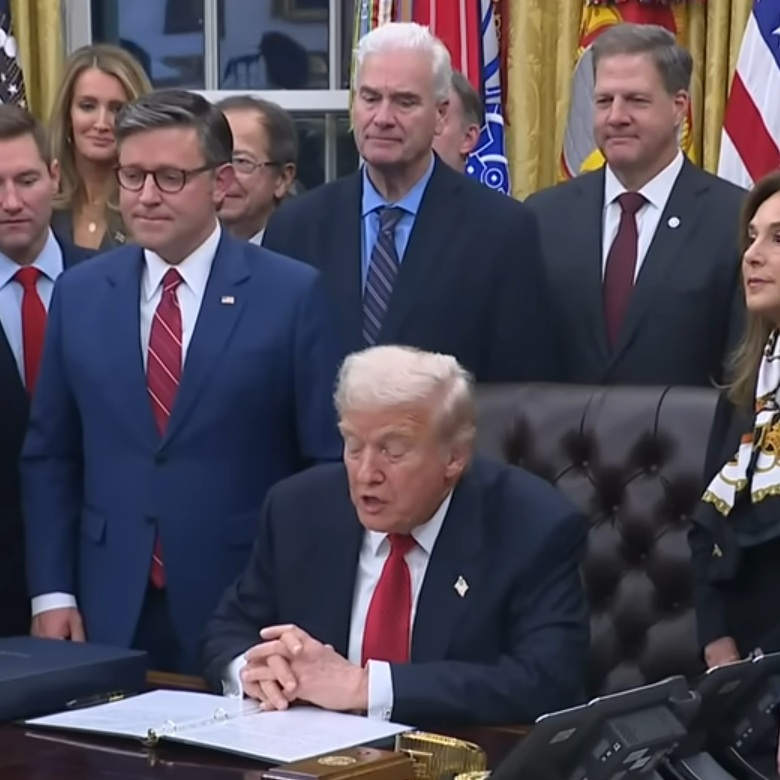
 President Donald Trump in the Oval Office Wednesday, at the signing event for the Continuing Appropriations, Agriculture, Legislative Branch, Military Construction and Veterans Affairs, and Extensions Act, 2026. Credit: White House
President Donald Trump said Wednesday evening, when he signed a bill that will provide the funding need to restore normal federal government operations, that he wants to replace the current Affordable Care Act subsidy system with a system for making cash payments directly to consumers.
"I'm calling today for insurance companies not to be paid, but for the money to be paid directly to the people of our country, so that they can buy their own health care, which will be far better and far less expensive than the disaster known as Obamacare," Trump said.
"I want the money to go directly to you, the people, and you'll go out, and you'll buy your own health insurance, and you'll negotiate different plans, and you'll get much better insurance," Trump said. "We're going to forget this Obamacare madness."
Trump talked about the cash-payment strategy during an event the White House held in the Oval Office to showcase Trump's signing of the Continuing Appropriations, Agriculture, Legislative Branch, Military Construction and Veterans Affairs, and Extensions Act, 2026 bill.
What it means: The signing of the anti-shutdown bill may have started a major new round of efforts in Washington to change the federal commercial health insurance subsidy system.
The backdrop: HealthCare.gov and other Affordable Care Act exchange programs, such as Covered California, serve as web-based supermarkets for individual and small-group health insurance from commercial health insurers.
The ACA exchange programs provide access to federal premium tax credit subsidies that people can use to pay for the exchange plan coverage.
Originally, when the ACA system for major medical insurance, or "Obamacare," came to life, in 2014, the ACA limited access to the premium tax credit subsidies to people with income under 400% of the federal poverty level.
Congress responded to the COVID-19 pandemic by temporarily increasing the subsidies. Congress also made the subsidies available to anyone who would have to pay more than about 10% of family income for standard coverage. The temporary subsidy boost is set to expire Dec. 31.
Democrats in Congress said in September, when they refused to vote for the funding bills to support normal federal government operations, that they wanted Republicans in Congress to first agree to extend the current high subsidy levels for people who buy their health coverage through the Affordable Care Act public exchange system.
The shutdown began Oct. 1.
Since then, some Republicans have called for shifting to cash-for-coverage strategies similar to the proposal Trump discussed Wednesday.
Trump brought up the idea in a post on Truth Social on Saturday and in an interview that aired on Fox News on Monday.
Some Republicans in Washington have supported extending high subsidy levels, at least temporarily.
Two, Rep. Kevin Kiley, R-Calif., and Rep. Don Bacon, R-Neb., agreed this week to cosponsor a bipartisan bill that would maintain access to subsidies for exchange plan users with income of up to 600% of the federal poverty level, or $192,900, for a family of four.
Force for change: One reason members of Congress are still talking about the ACA premium subsidies is that a new partial government shutdown is already on the horizon: Much of the funding provided by the act Trump signed Wednesday will expire Jan. 30, 2026.
Reactions: Many health policy players are still hoping that Congress will make a deal to keep a high level of premium subsidies in place.
Mike Tuffin, the chief executive officer of America's Health Insurance Plans, said Congress should extend the current subsidy levels while the Affordable Care Act open enrollment period for 2026 coverage is still underway.
The enrollment period started Nov. 1 and is set to end Dec. 15.
Sarah London, the CEO of Centene, a major Medicaid plan and exchange plan issuer that has some group health operations, said Tuesday, at a conference for investors organized by UBS, that she thinks the future of the current ACA premium subsidy levels could take three tracks.
"One is that they expire," London said, according to a recording of the event posted on Centene's website. "One is that you get maybe a 1-year extension, so that they [members of Congress] can actually work through reform. And, then, perhaps there's enough alignment around the highest value items, relative to reform, that something else could come together quickly."
But London noted that Centene has based its own 2026 premiums on the assumption that the current high subsidy levels will expire.
Josh Schultz, head of government affairs at Softheon, a company that supports ACA exchange programs and other health insurance market players, said via email that he thinks an end-of-the-year health package could include an extension of the current subsidy levels and, possibly, a provision putting the individual coverage health reimbursement arrangement rules in federal law.
But he said he does not believe that supporters of the package would have enough votes to get it through the Senate, even though Senate leaders have agreed to consider a subsidy level extension.
Pay-fors: Even though a new health subsidy fight might have a direct effect only on users of individual coverage, it still could end up affecting employer-sponsored health coverage.
Congressional negotiators could add a wide range of group health provisions to any major new health insurance bill.
Another factor is rules that require members of Congress to offset the impact of their proposals on the federal budget deficit by adding federal revenue or cutting federal spending.
The health premium bill that Kiley and Bacon are cosponsoring, the Fix It Act bill, includes a "pay-for" that could affect how much extra federal subsidy money Medicare Advantage plan issuers get for covering high-risk Medicare enrollees.
The Fix It Act bill pay-fors would not affect employer-sponsored health plans, but they show that lawmakers are looking hard for pay-fors.
In the past, some policymakers have considered using caps on the federal income tax exclusion for employee health benefits as a pay-for.
© Arc, All Rights Reserved. Request academic re-use from www.copyright.com. All other uses, submit a request to TMSalesOperations@arc-network.com. For more information visit Asset & Logo Licensing.