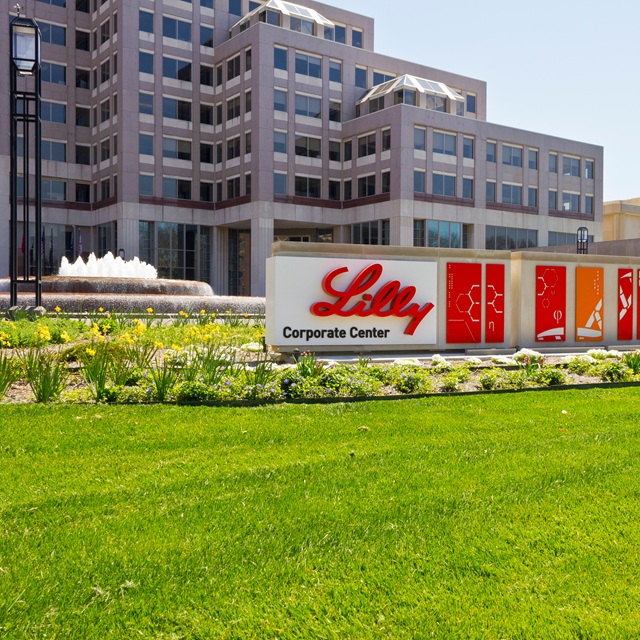
 Eli Lilly's headquarters in Indianapolis. Credit: jetcityimage/Adobe Stock
For employer-sponsored health plans, the implications of covering, or not covering, GLP-1 agonist weight-loss drugs and similar types of drugs could get a lot more complicated in 2026
Executives from Eli Lilly said last week that they hope their new GLP-1 agonist weight-loss tablet, orforglipron, will be on the market by early spring — and that they think a weight-loss tablet could be more popular than an injectable drug.
In studies, orforglipron has helped patients in studies lose about 12% of their body weight. Novo Nordisk's injectable drug Wegovy helped obese patients lose 17% of their weight in one study, and Eli Lilly's injectable drug Zepbound helped patients lose 20% of their weight.
"We've seen many providers, as well as many people, not ready for an injectable therapy," Ilya Yuffa, an executive vice president at Lilly, said last week at a health conference organized by Citi. "We see an oral option being a great entry point."
In other cases, Yuffa said, patients could start by taking Zepbound — a weight-loss drug that acts both as a GLP-1 agonist and a GIP agonist — and then use orforglipron or another oral weight-loss drug to keep weight off once they've reached their preferred weight.
Yuffa emphasized that predicting what will happen to the market for the new weight-loss drugs is difficult.
"What's probably best to predict is that all of our forecasts are typically wrong," Yuffa said.
But having access to an oral version of an effective weight-loss drug should increase the number of people who try using a prescription weight-loss drug, Yuffa said.
Eli Lilly executives told officials in the Trump administration in November that they would try to hold the cost of at least one form of orforglipron to an average of $346 when consumers buy the drug directly from the new TrumpRx.gov prescription drug access site.
Eli Lilly streamed the conference live on the web and has posted a recording on its website.
What it means: About 5% of U.S. adults may already be taking Wegovy or its rivals, such as Zepbound and Mounjaro.
Once pills are available, the percentage of adults using the drugs could soar.
A recent eHealth survey suggested that typical overweight or obese adults are open to spending more than $200 per month out of their own pockets for effective weight-loss drugs, implying that total U.S. spending could soon pass $200 billion per year.
The drugs: Novo Nordisk, the maker of Wegovy, already makes Rybelsus, a GLP-1 agonist tablet.
But that drug is officially classified as a drug that helps people with diabetes control their blood sugar, not as a weight-loss drug, and it must be taken on an empty stomach.
Analysts say orforglipron could be more successful because people can choose to take it with or without food or water.
Eli Lilly also has another closely watched weight-loss drug in the pipeline: retatrutide. That's an injectable drug that acts as a GLP-1 agonist, as a GIP agonist and as a glucagon. It may help people lose 24% of their body weight.
Novo Nordisk, meanwhile, is seeking U.S. regulator approval to sell an oral version of Wegovy.
© Arc, All Rights Reserved. Request academic re-use from www.copyright.com. All other uses, submit a request to TMSalesOperations@arc-network.com. For more information visit Asset & Logo Licensing.