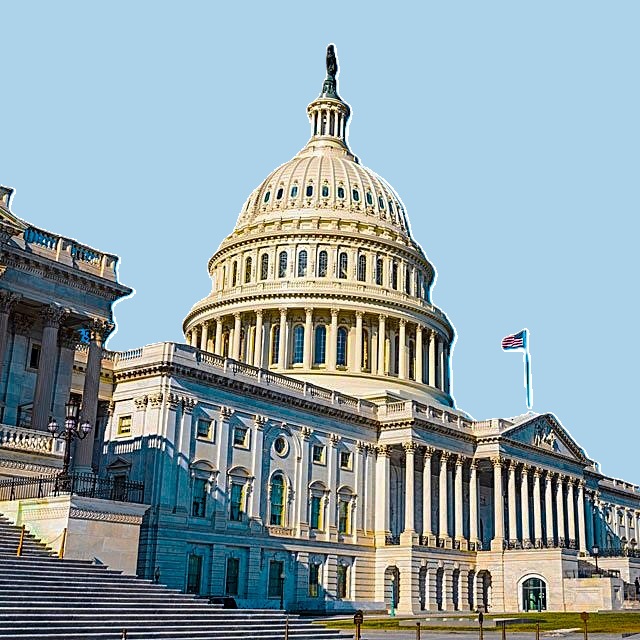
 The U.S. Capitol. Credit: Shutterstock
The Senate today failed to bring two Affordable Care Act subsidy extender bills up for a vote on the floor.
But a majority of senators voted to allow floor debate on each bill, and there appeared to be signs that the death of the effort to provide at least a partial extension could be temporary.
Over in the House, Rep. Jennifer Kiggans, R-Va., rounded up 37 cosponsors — including 22 Democrats and 15 Republicans — for the CommonGround for Affordable Health Care Act bill.
The backdrop: Congress is focusing on the ACA premium subsidies because a temporary boost provided in response to the COVID-19 pandemic is set to expire Dec. 31.
The boost made subsidies available to people at any income level if the cost of coverage would eat up more than about 9% of their income. If the boost expires, subsidies will be available only to people who earn less than 400% of the federal poverty level. That's $62,600 for an individual this year in most of the United States and $128,600 for a family of four.
Kaiser Family Foundation analysts have estimated that out-of-pocket costs for a typical family could double of the COVID subsidy boost expires. Some relatively high-income bloggers have reported online that they think the cost of keeping their coverage in place could increase from less than $8,000 this year to more than $50,000 in 2026.
The Senate votes: The backers of the Senate ACA subsidy extender bills need 60 votes to get the bills to the Senate floor without worries about the threat of a "filibuster," or an endless round of debate.
A bill introduced by Sen. Chuck Schumer, D-N.Y., the Senate minority leader, would extend the current level of subsidies for three years.
A Republican alternative introduced by Sen. Mike Crapo, R-Idaho, and Sen. Bill Cassidy, R-La., would let the current subsidy levels expire; provide funding for another type of ACA subsidy, a cost-sharing reduction subsidy; and provide cash for health savings accounts for low-income and moderate-income individuals. The HSA contribution would be $1,000 for adults under 50 and $1,500 for adults ages 50 to 64.
Senators voted 51-48 for cloture for both bills.
No Democrats or independents who ally themselves with the Democrats crossed party lines to vote for the Crapo-Cassidy bill, and Sen. Rand Paul, R-Ky., crossed party lines to vote against it.
All Democrats voted for the Schumer bill, and the Schumer bill also attracted votes from four Republicans: Susan Collins of Maine, Josh Hawley of Missouri, Lisa Murkowski of Alaska, and Dan Sullivan of Arkansas.
The bipartisan House bill: Over in the House, Jennifer Kiggans' ACA extender bill would:
◆ Extend a high level of ACA premium subsidies for one year for users of individual and family exchange coverage with income up to 1,000% of the federal poverty level. That means individuals with income of up to about $156,500 and families with income up to about $321,500 might be eligible for at least some subsidies if the cost of coverage would exceed 10% of their income.
◆ Add provisions meant to keep the ACA public exchange system from providing premium tax credit subsidies for people who lie about their eligibility for the subsidies.
◆ Impose restrictions on the pharmacy benefit managers that work with Medicaid and Medicare plans.
The public health plan PBM sections appear to be similar to a public health plan PBM section included in a bill recently proposed by the leaders of the Senate Finance Committee — Sen. Mike Crapo, R-Idaho, the chairman, and Sen. Ron Wyden, D-Ore., the highest-ranking Democrat.
Public health plan PBM provisions and employer plan PBM provisions have appeared in several other bills involved in the current ACA subsidy debate. The provisions might be showing up partly because they have broad, bipartisan support and partly because pharmacists and their lobbyists have been working hard to bring Republicans and Democrats together.
Evidence of ACA extender fight life: Some observers have said that efforts to extend the current ACA premium subsidy levels before the end of the year are now dead.
But some health policymakers in Washington seem to think that passage of some kind of extender legislation is still possible.
Charlene MacDonald, an executive vice president at the Federation of American Hospitals, put out a statement noting that "Americans living paycheck to paycheck face a disastrous choice: take on debt to afford skyrocketing premiums or risk going without coverage entirely."
"Congress cannot leave their constituents in this bind," MacDonald said. "Now is not the time for partisan exercises; now is the time to get a pragmatic solution across the finish line and immediately extend the health care tax credits."
What it means: Employers and benefits advisors with an interest in federal health benefits legislation may need to keep mobile phones visible during the holidays and leave breaking news notifications turned on.
© Arc, All Rights Reserved. Request academic re-use from www.copyright.com. All other uses, submit a request to TMSalesOperations@arc-network.com. For more information visit Asset & Logo Licensing.