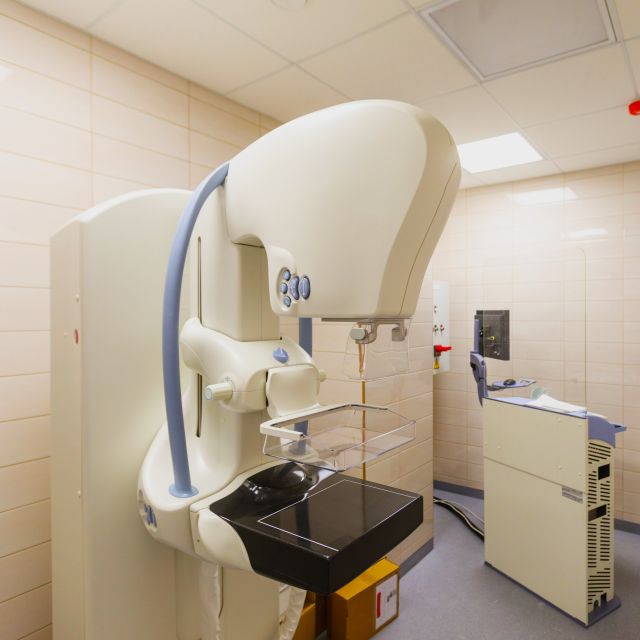
 A mammography X-ray machine. Credit: Diflope/Adobe Stock
Adding breast cancer screening for high-risk women and reducing screening for low-risk women may save time and money without having much impact on the screening results.
A team of medical researchers led by Dr. Laura Esserman of the University of California, San Francisco, have published a paper supporting that conclusion on a website affiliated with the Journal of the American Medical Association.
What it means: If the researchers are correct, employers' health plans might be able to save money on mammograms without hurting plan participants' health.
Controlling the cost of breast cancer screening is important, because, in the United States, "the aggregate annual cost of screening exceeds the U.S. Centers for Disease Control and Prevention's core public health program budget, and projected costs vary 4-fold, depending on the guideline implemented," the researchers wrote in their paper.
The backdrop: Cancer screening mandate proposals tend to be popular both in state legislatures and in Congress.
The Affordable Care Act requires employers' plans to cover many cancer screening tests without imposing co-payments, deductibles or other cost-sharing requirements on the patients.
Members of Congress often introduce bills that would expand cancer screening mandates. In 2024, for example, one bill introduced could have required plans to begin covering mammograms for women starting at age 30.
But research on whether broad preventive screening programs save money, or save people's lives or improve people's quality of life, has been scarce.
The new paper appeared in December. A team cited by the authors of the new paper reported earlier in 2025 that U.S. commercial plans are paying an average of $44,000 per case of breast cancer detected using 2D mammography X-ray machines, and that the average lifetime cost of providing breast cancer screening in the United States could range from $6,931 per women, based on recommendations from the U.S. Preventative Services Task Force, up to $13,416 per woman, based on recommendations from the American College of Radiology.
The study: The researchers who conducted the new study recruited 28,372 women ages 40 through 74 for the research pool and used a random process to assign them to two groups.
One group received recommendations to get mammograms every year.
Researchers used a simple genetic screening test, a family history questionnaire and an initial assessment of breast health to put the women in risk groups.
Some of the women in "risk stratified group" were told they could wait until they were 50 to get mammograms, and the women in the higher risk categories received extra screening. The women in the highest-risk categories, who were believed to have more than a 6% risk of developing breast cancer within five years, were told get get a mammogram or a breast MRI every six months.
The results: The women in the risk-stratified group were 8.2% less likely to get mammograms than the other women but 49% more likely to get MRIs.
Doctors found cancers at Stage IIA or higher at a rate of 88 per 100,000 women per year in the women in the risk-stratified group. That detection rate was 24% lower than for the women who received a recommendation to have annual mammograms.
A Stage IIA cancer has about 1-inch wide or smaller but cancer cells have spread to at least some lymph nodes.
Although the detection rate was lower in the risk-stratified group, the difference was small enough that, from a medical prespective, the risk-stratified approach was non-inferior, according to the researchers.
© Arc, All Rights Reserved. Request academic re-use from www.copyright.com. All other uses, submit a request to TMSalesOperations@arc-network.com. For more information visit Asset & Logo Licensing.