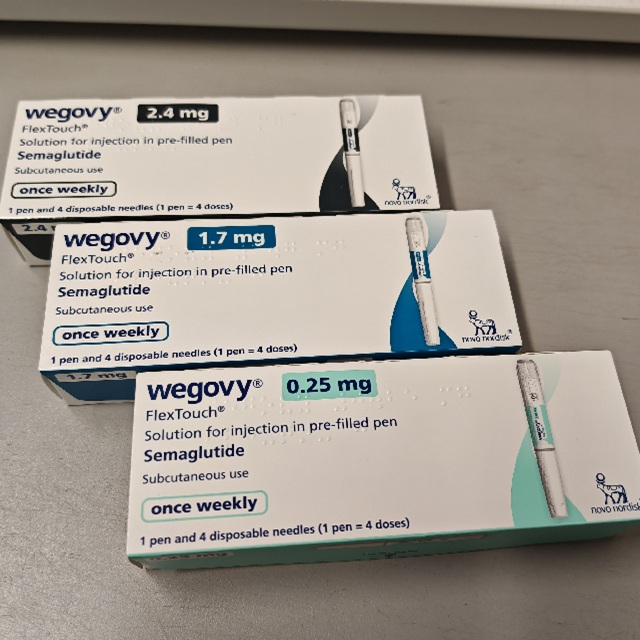
 Boxes of Wegovy injectors. Credit: Semi/Adobe Stock
Wegovy and other weight-loss drugs that contain GLP-1 agonists may make the employer health plan participants who take the drugs look and feel better, but the drugs probably won't improve the participants' health enough to offset the cost of the drugs.
Coady Wing, an Indiana University economist, and three colleagues have reported that finding in a working paper posted on the website of the National Bureau of Economic Research.
A working paper is a research paper that has not yet been through a full peer review process.
What it means: Employers who are hoping that the expensive new weight-loss drugs will somehow pay for themselves may be disappointed.
The research strategy: Wing and his colleagues started with data for 2016 through 2023 from an employer health plan claim data database managed by Merative, the organization formerly known as IBM Watson Health.
The database included information about 750,000 plan participants who had taken GLP-1agonists for obesity, diabetes or other conditions.
Some of the patients took Wegovy or Ozempic, drugs that contain semaglutide, and other patients took other types of GLP-1 agonists.
The plans in the database spent an average of about $22,000 on the drugs over five years for any patients who started taking the drugs, the researchers found.
The results: Taking GLP-1 agonists did not appear to decrease overall plan spending on those patients, and increases in outpatient spending may have increased average costs for those patients by about $6,800 per patient, the researchers report.
The researchers emphasize that they looked only at the impact over five years and that most of the patients took semaglutide or older drugs.
"It is possible that future molecules will produce large offsets or that patients with obesity will eventually show larger cost offsets," the researchers write. "We expect, however, that short- and medium-term cost offsets would be greater for patients with diabetes, who have worse baseline health and higher health care spending."
The backdrop: Drug manufacturers and other entities have found that GLP-1 agonists have a big effect on the odds that patients will have heart attacks, cancer and other obesity-related conditions.
A team led by a University of Chicago medical school research reported in March 2025 that semaglutide might have enough benefit to cost less than $100,000 per quality-adjusted life year once its price falls to $1,522 per year.
Coady and his colleagues say their results might be different because they looked at the impact of GLP-1 agonists on relatively healthy people in the general population, not on high-risk patients who already have serious health problems, and because their research included the cost of outpatient monitoring for the patients taking the GLP-1 agonists, not just the cost of drugs and inpatient hospital care.
© Arc, All Rights Reserved. Request academic re-use from www.copyright.com. All other uses, submit a request to TMSalesOperations@arc-network.com. For more information visit Asset & Logo Licensing.