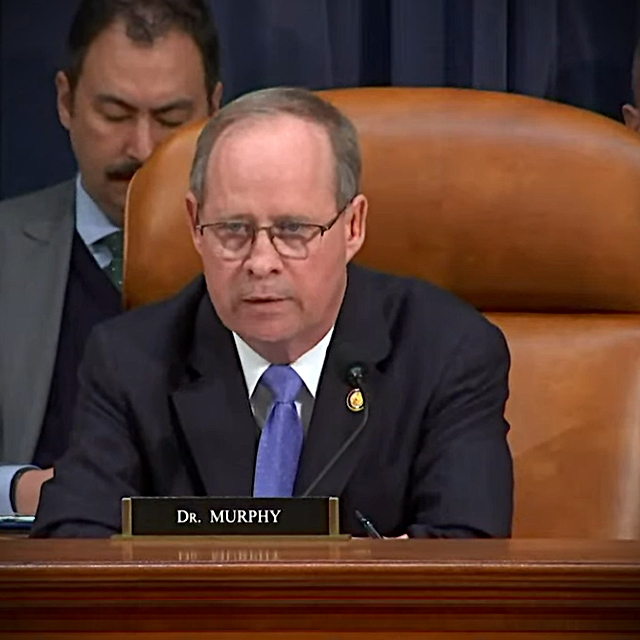
 Rep. Greg Murphy, R-N.C., talked about the health insurance claim denials he himself has faced Thursday at a House Ways and Means Committee hearing featuring health insurance company CEOs. Credit: House Ways and Means Committee
The House Ways and Means Committee brought the chief executive officers of four giant health insurance companies in for grilling Thursday, and the harshest remarks came from a Republican on the committee: Rep. Greg Murphy, R-NC.
Murphy, a urologist who has been coping with benign brain tumor, told the CEOs of Cigna, Elevance Health, UnitedHealth and Aetna parent CVS health that their companies have "put profits above patients" and "profits above those who care for patients."
"If it were up to me, I would throw out all for-profit systems in this country and turn everybody into nonprofit," Murphy said. "It has gotten that bad."
He said CVS Health was in charge of approving his use of a drug prescribed by his physician.
"There has been systematic denial and delay of care," Murphy said. "It took me [overcoming] eight denials to get a medicine I need to exist. I'm a physician and a member of Congress. It took me eight times through CVS to get that medication. I didn't pull any strings. I did what I was supposed to do. Imagine the average person in this country. There has been a weaponization of prior authorization. You are killing people who are delivering health care."
Murphy also blasted "vertical integration," or efforts by some types of players in the health care finance and delivery system to acquire their service providers.
"The vertical integration that has occurred in this country is disastrous and criminal," Murphy said. "There have been record profits. I don't want to hear about the fact that you're not taking profits. We know how money gets moved around in these companies.... I don't agree with Mark Cuban often, but we do agree that what needs to happen is that you need to be broken up... Again, if I had my way, I'd turn all of you guys into dust. We'd start back from scratch. We'd have competition in the industry. We'd have association health plans. And we would have nonprofit hospitals rather than profit being put over patients."
Murphy went on to attack the compensation of the health insurance company CEOs and the insurers' promises, made at an event organized by the U.S. Department of Health and Human Services and the Centers for Medicare and Medicaid Services, to reduce the burden of health plan prior authorization procedures on the patients and health care providers asking the plans for approvals for use of certain types of health care products and procedures.
"I won't believe any of that until I see it," Murphy said. "So far, I've seen nothing."
The new federal No Surprises Act system is supposed to protect insured patients who get certain kinds of health care from big out-of-network medical bills and require providers and plans to resolve differences over billing through a dispute resolution system. The insurance CEOs have been asking Congress to help them keep investor-owned hospitals and provider groups from using the system to drive up claim payments.
Murphy told the CEOs that their companies are the ones gaming the system.
"You all owe and keep millions of dollars that are owed to providers today, that you're not paying them, that have been adjudicated in their favor," Murphy said. "That is fraud."
Murphy also expressed skepticism about UnitedHealth's promise, made Wednesday, to return any profits it makes from Affordable Care Act exchange plans this year to the enrollees.
"I wonder whether it would have occurred if these hearings had not been here," Murphy said.
House Ways and Means streamed the hearing live and posted a recording on its website.
The committee has jurisdiction over health insurance partly because of its role in shaping rules governing the income taxes of health insurers and employers' health benefit plans.
The hearing: The House Energy and Commerce Committee's health subcommittee brought the same CEOs — David Cordani of Cigna, Gail Boudreaux of Elevance, Stephen Hemsley of UnitedHealth and David Joyner of CVS — in for another, similar hearing earlier in the day.
Rep. Jason Smith, R-Mo., the House Ways and Means Committee chairman, thanked the CEOs for agreeing to appear voluntarily "before the best committee in Congress."
Other participants: Smith said at the start of the hearing that insurers' revenue has been made possible by the U.S. taxpayer.
Over 10 years, "the tax break for employer-sponsored coverage is worth $4 trillion," Smith said.
Rep. Mike Kelly, R-Pa., noted that a family auto dealership company now managed by his son will spend $1.5 million on health insurance this year.
ReShonda Young, the owner of TnK Health and Nutrition in Waterloo, Iowa, said she and her employees depend on the Affordable Care Act public exchange system and ACA premium tax credit subsidies for health coverage.
Because a temporary premium subsidy boost expired Dec. 31, 2025, and Congress has not extended the subsidy boost or provided an alternative arrangement, her share of the premiums increased to $592 per month this year, from $94 per month in 2025.
"That's a difference of $498 every single month," Young said.
She reported that she also had to a shift to a leaner plan and watch her deductible increase to $7,500, from $1,500.
The CEOs offered suggestions for reducing the cost of care.
Cordani, for example, said the country must do more to prevent chronic illness; do more to reward health care providers and drug manufacturers based on health care outcomes rather than the amount of care provided; and increase the level of competition.
© Arc, All Rights Reserved. Request academic re-use from www.copyright.com. All other uses, submit a request to TMSalesOperations@arc-network.com. For more information visit Asset & Logo Licensing.