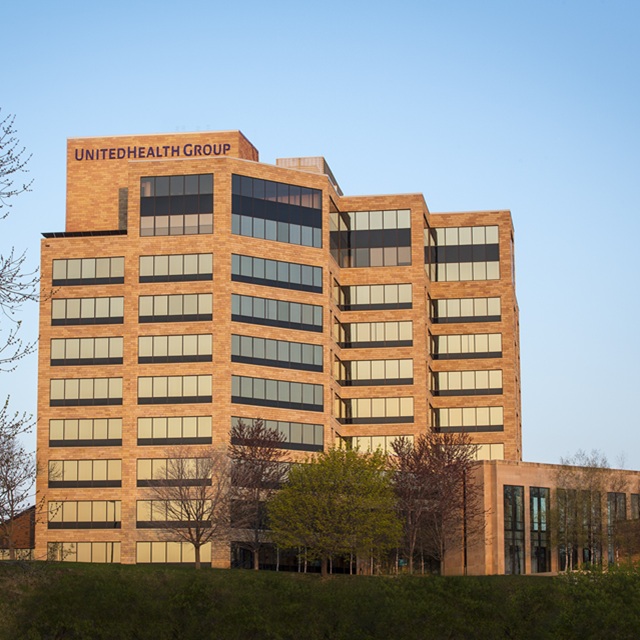
 UnitedHealth's headquarters in Minnetonka, Minnesota. Credit: Steve Niedorf
UnitedHealth Group executives today predicted that the number of people with its fully insured commercial health coverage will fall about 16% this year, to less than 6.9 million.
"We expect both fully insured group and individual enrollment to contract," according to Timothy Noel, the chief executive officer of UnitedHealth's UnitedHealthcare health insurance business.
Noel and other UnitedHealth executives talked to securities analysts about the company's performance on a conference call.
The company did not say how many of the 8.2 million people who have its commercial coverage today are in employer plans.
But Dan Schumacher, president of UnitedHealth, said that about 500,000 of the 1.3 million to 1.4 million in commercial enrollment losses will affect individual coverage. That implies that 800,000 to 900,000 of the projected losses will happen at employer plans.
UnitedHealth executives are preparing for enrollment to fall because UnitedHealthcare is increasing coverage prices to cope with rising medical costs.
In October, executives said they thought premiums would rise an average of 11% this year.
For commercial coverage, "that's probably still a good place to orientate to," Noel said.
UnitedHealthcare is encouraging small employers to shift to self-insured health insurance arrangements administered by UnitedHealth, including level-funded plan arrangements, rather than dropping health benefits or going to other carriers. Level-funded plans use reinsurance to keep self-insured employers' monthly coverage costs stable.
So far this year, "we've found the market to be firm and competitive," Schumacher said.
The results suggest that UnitedHealthcare will be able to meet its profit improvement goals for the year, he said.
UnitedHealth held the analyst call to go over results for the fourth quarter and all of 2025.
The company streamed the call online and posted a recording on its website.
What it means: For UnitedHealth, fully insured commercial health insurance is no longer a top priority.
Only about 16.4% of UnitedHealth health insurance enrollees were in fully insured commercial coverage at the end of 2025, down from 17.6% a year earlier.
Roughly 43% of the enrollees are in self-insured employer plans, and half are in Medicare plans, Medicaid plans, and other types of government plans.
The earnings: UnitedHealth is reporting $218 million in net income for the quarter on $113 billion in revenue, compared with $5.8 billion in net income on $101 billion in revenue for the fourth quarter of 2024.
UnitedHealth reported $429 billion in revenue for all of 2025. Its full-year revenue is comparable to the gross domestic product, or national income, of Denmark and Malaysia, according to World Bank GDP data.
Revenue at the UnitedHealthcare Employer & Individual domestic business fell 0.8% from the year-earlier level, to $18.9 billion.
The number of people with coverage insured or administered by UnitedHealth's divisions decreased 0.7%, to 50 million.
The number of enrollees in fully insured commercial coverage fell 7.7%, to 8.2 million, and the number in self-insured employer health plans increased 2.9%, to 21.5 million.
Brown & Brown's perspective: Brown & Brown, a big benefits and insurance broker, released its fourth-quarter earnings Monday and held an analyst call of its own today.
Brown & Brown reported $268 million in net income for the fourth quarter on $1.6 billion in revenue, up from $210 million in net income on $1.2 billion in revenue for the fourth quarter of 2024.
"Pricing for employee benefits increased slightly as compared to prior quarters, with medical costs up 7% to 9% and pharmacy costs up over 10%," according to J. Powell Brown, the CEO. "We do not see any signs that this trend will slow."
But Brown said he thinks the economies in which the firm operates will be stable this year.
"Even though the headlines may potentially indicate something else, that's not actually what we see," Brown said. "We feel good about the backdrop."
PBM popularity: Pharmacies and drug manufacturers have been clashing with the pharmacy benefit managers in state legislatures and in Congress.
Employer groups have been supporting the pharmacies' and drug manufacturers' efforts to lobby for federal PBM transparency legislation and other PBM rule changes.
One question about the PBM wars is whether typical employers and other health plan sponsors are really unhappy with their PBMs.
The PBMs have argued that customers seem to like them: Sales have been strong.
Patrick Conway, the CEO of UnitedHealth's Optum health services division, said today that the number of people served by the Optum Rx is falling because of falling enrollment at UnitedHealthcare's own plans.
But Optum Rx had a strong external selling season, and it has recently added about 800 new customer relationships, Conway said.
© Arc, All Rights Reserved. Request academic re-use from www.copyright.com. All other uses, submit a request to TMSalesOperations@arc-network.com. For more information visit Asset & Logo Licensing.