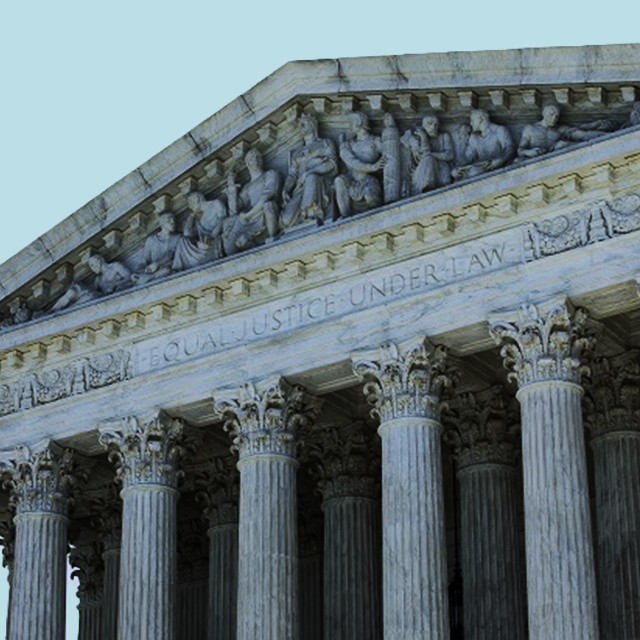
 The West Pediment of the U.S. Supreme Court. Photo: Diego M. Radzinschi/TouchPoint Markets
The U.S. Supreme Court today issued a complicated ruling on trade tariffs that could end up helping employers, health insurers and benefits advisors fight federal regulations.
The justices voted 6-3 that President Donald Trump has no authority under the federal International Emergency Economic Powers Act to respond to international drug trafficking or large trade deficits by imposing trade tariffs.
The case is Learning Resources v. Trump.
A tariff is a tax on imports.
Three of the justices — John Roberts, Neil Gorsuch and Amy Coney Barrett — held that IEEPA gives Trump no authority to impose broad tariffs, partly because IEEPA does not mention tariffs, and partly because a philosophy called the "major questions doctrine" requires Congress to be clear if it is delegating a major power to the president.
Three justices — Sonia Sotomayor, Elena Kagan and Ketanji Brown Jackson — agreed that Trump has no authority under IEEPA to impose emergency tariffs but declined to support use of the major questions doctrine.
The judges filed a total of seven opinions: the main opinion, four concurring opinions and two dissents.
The justices refer frequently in the opinions to previous Supreme Court rulings on suits filed by employer groups such as the National Federation of Independent Business and the Alabama Association of Realtors.
What it means: Parties in future suits involving federal employment laws and federal benefits rulings could cite the Learning Resources ruling when they're fighting on any federal agency effort to do something not explicitly described in a federal statute.
Deference: The Supreme Court shook up all federal regulatory efforts in 2024 when it ruled on the Loper Enterprises v. Raimondo case.
That ruling knocked out the Chevron doctrine, which once required federal courts to give deference to the views of federal agencies in many situations.
The Chevron doctrine previously helped increase the clout of the president and federal agencies.
Employer groups and benefits groups welcomed the Loper Bright ruling, suggesting that employers could use the ruling to overturn unwanted health and benefits requirements.
Major questions: The Learning Resources ruling could also affect future cases that relate to the major questions doctrine.
The major questions doctrine states that "We expect Congress to speak clearly if it wishes to assign to an agency decisions of vast 'economic and political significance,'" according to a quote from the late Supreme Court Justice Antonin Scalia that was included in the dissenting opinion written by Justice Brett Kavanaugh.
Kavanaugh backed Trump's ability to impose emergency tariffs, but he wrote that he supports the major questions doctrine.
In the past, the National Federation of Independent Business and other organizations have cited the major questions doctrine as one reason for the courts to block regulations that, from the perspective of employers, appear to exceed federal agencies' statutory authority.
The doctrine came up when the Supreme Court backed efforts by the NFIP to oppose a COVID-19 vaccine mandate imposed by the DOL's Occupational Safety and Health Administration.
Employer groups have cited the doctrine when opposing DOL regulations and interpretations related to independent contracts, according to an analysis by a team at JacksonLewis.
Affordable Care Act cases: The Supreme Court agreed in October to consider a case involving state efforts to regulate health care cost-sharing ministries, or religious groups that agree to use contributions from members to help pay other members' medical bills. The Learning Resources ruling could affect how the court sees any federal interpretations of the Affordable Care Act laws that affect states' interactions with the ministries.
The Learning Resources ruling could also affect how the court sees federal agency efforts apply the Affordable Care Act nondiscrimination requirements to health coverage for transgender individuals.
© Arc, All Rights Reserved. Request academic re-use from www.copyright.com. All other uses, submit a request to TMSalesOperations@arc-network.com. For more information visit Asset & Logo Licensing.