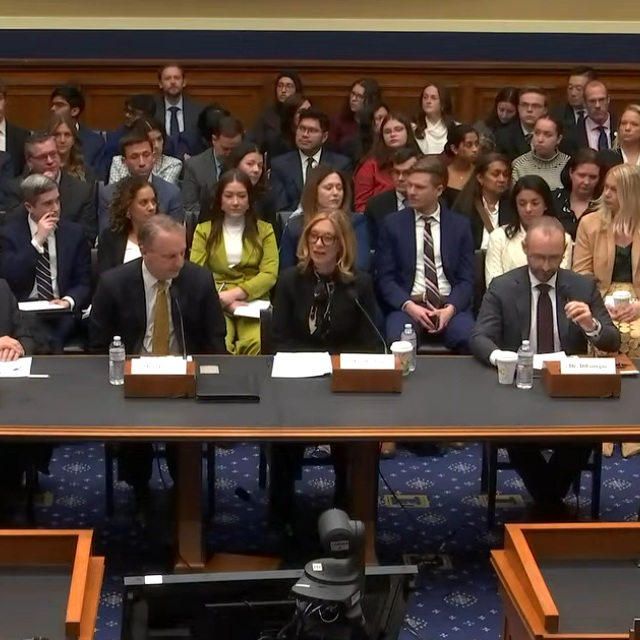
 Purchaser Business Group on Health CEO Elizabeth Mitchell testified today at a House Energy & Commerce subcommittee hearing on health care costs. Credit; House Energy & Commerce Committee
Congress may try to press hospitals to do a better job of complying with existing federal price reporting rules.
The possibility came up today as the House Energy & Commerce Committee's Health Subcommittee held a hearing on health care costs.
Both Republican lawmakers and Democratic lawmakers at the hearing seemed interested when talking to Elizabeth Mitchell, one of the witnesses, about hospital price transparency concerns.
Mitchell, the chief executive officer of the Purchaser Business Group on Health, told lawmakers that she thinks that making hospitals comply with federal requirements to post machine-readable files containing all negotiated service prices on their websites would go a long way toward helping employers and patients shop for high-quality, reasonably priced care.
Today, hospital price information "is increasingly usable," Mitchell said. "Unfortunately, we do not have good compliance."
Only 69% of hospitals post the information they're supposed to post, she said.
"I think enforcement is, at this point, warranted," Mitchell said.
Purchaser Business Group on Health: PBGH represents large, self-insured employers.
The group's member employers provide health coverage for 25 million people.
The backdrop: House Energy and its Health Subcommittee have been holding many hearings on health care costs.
Members of the committee helped put two provisions requiring more transparency from pharmacy benefit managers in the new Consolidated Appropriations Act of 2026.
Transparency came up often at a hearing on prescription drug prices that the Health Subcommittee held in February.
David Marin, the new CEO of the Pharmaceutical Care Management Association — the pharmacy benefit managers' trade group — said PCMA would like to see more transparency for all players in the drug supply chain.
Mitchell's testimony: Mitchell said at the hearing that soaring health care costs can quickly turn a worker's medical emergency into a financial disaster.
Too often, she said, a patient enters a hospital and comes out with an unexpected $100,000 bill.
"It's not responsible for the system to burden patients with that kind of cost," Mitchell said.
PBGH wants to see policymakers improve the way the health care delivery system works by redirecting more resources toward high-value, under-funded types of care, such as primary care, maternity care and mental care, and by attacking health care provider consolidation and other trends that hurt employers' ability to negotiate for fair health care prices, Mitchell said.
In some cases, she said, provider consolidation and provider contracting strategies require employers to buy access to care from providers far from where the plan participants live.
Provider consolidation and provider contracting practices may also force plan sponsors to keep high-cost, low-quality providers in their networks, Mitchell said.
"All of the evidence shows that consolidation drives up prices between 3% and 60% with absolutely no benefit to quality or access," she said.
© Arc, All Rights Reserved. Request academic re-use from www.copyright.com. All other uses, submit a request to TMSalesOperations@arc-network.com. For more information visit Asset & Logo Licensing.