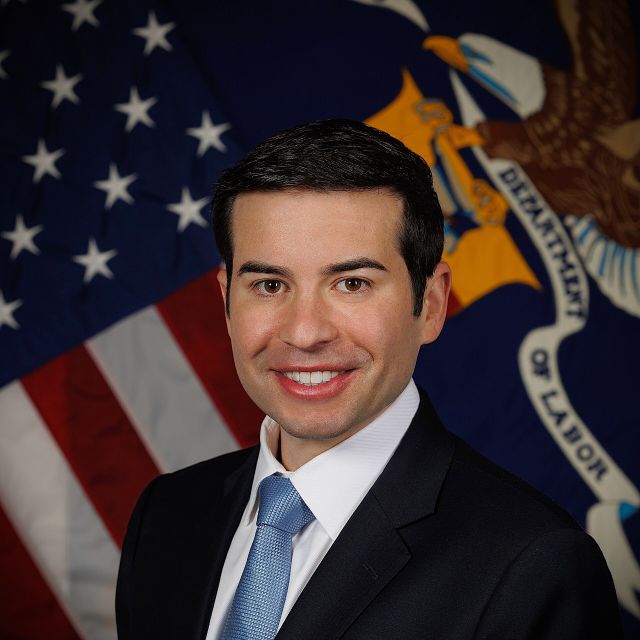
 Keith Sonderling. Credit: DOL
Lori Chavez-DeRemer has resigned from her post as secretary of the U.S. Department of Labor, White House officials announced Monday.
Chavez-DeRemer, who previously served in the U.S. House of Representatives, left the DOL post amid allegations that she had used office resources to pay for personal travel and other personal expenses.
Keith Sonderling, the deputy Labor secretary, has taken over as the department's secretary.
Sonderling has been visible in department efforts to put more emphasis on informal efforts to work with employers and less on formal investigations.
He has also backed efforts to ease restrictions on use of alternative assets in 401(k) plans, promote health care price transparency, regulate pharmacy benefit managers and protect worker safety.
What it means: Under Sonderling, the Labor Department might focus more on benefits issues.
Keith Sonderling: Sonderling was born in New York and grew up in Boca Raton, Florida.
Sonderling started his career as a labor and employment lawyer. In 2017, he began working for the Labor Department's Wage and Hour Division. He served as the division's acting administrator in 2019.
From 2019 through 2024, he was one of the commissioners at the Equal Employment Opportunity Commission.
The Senate confirmed him as deputy secretary of the Labor Department in March 2025 with a party-line vote.
He has participated in many tech, financial and benefits industry events, including a 2025 conference panel organized by the ERISA Industry Committee.
Sonderling has a bachelor's degree in broadcast journalism from the University of Florida and a law degree from Nova Southeastern University.
Sonderling's views: While running the Wage and Hour Division, Sonderling ruled that gig workers are independent contractors, not employees of the entity that oversees the gig work.
While President Joe Biden was in office, the Labor Department withdrew that opinion.
After Donald Trump returned to the White House, the department reinstated the opinion.
Since Sonderling became deputy Labor secretary, he has spoken out often on department efforts.
He has talked about the need for the Labor Department to support use of employer self-audits, rather than criminal investigations or litigation, and to support defined benefit pension plan sponsors' efforts to use group annuities to protect pension benefits through pension risk transfers.
He has frequently called for an end to rules that exclude any possibility of employers including options such as cryptocurrency assets or private credit funds on retirement plan investment menus.
"The department's days of picking winners and losers are over," Sonderling said in March, in response to the release of a proposed regulation that describes how plan fiduciaries should evaluate alternative assets. "Our rule clearly spells out that managers must evaluate any and all potential product offerings by following a prudent process. This proposal is decidedly neutral and refrains from saying that any asset class is any better or worse than other investment types, as the law requires."
He has also talked about the need for workers to have clear information about health care prices.
After a worker fell through a residential skylight in Florida and was seriously injured, Sonderling highlighted a Labor Department move to propose $700,000 in penalties for a roofing contractor in connection with allegations of safety violations.
"Our workers are the backbone of this country, and we strive every day to ensure they never pay the ultimate price for a paycheck," Sonderling said.
Artificial intelligence: Sonderling is the lead author of a 2022 law review article about the possible benefits and dangers of using AI in connection with employment.
"AI promises to help workers find their most rewarding jobs, match companies with their most valuable and productive employees, and advance diversity, inclusion and accessibility in the workplace," according to the article abstract. "Notwithstanding its positive impacts, however, AI poses new perils for employer discrimination, especially when designed or used improperly."
Social media background checks, for example, "could collect information regarding an applicant's race, sex, sexual identity, disability, pregnancy, or health, which employers cannot lawfully consider during the hiring process," Sonderling and his two coauthors wrote in the article.
The authors noted, based on an article that ran in BenefitsPRO in 2021, that errors in data used to train an AI system could affect how well an AI system makes decisions.
© Arc, All Rights Reserved. Request academic re-use from www.copyright.com. All other uses, submit a request to TMSalesOperations@arc-network.com. For more information visit Asset & Logo Licensing.