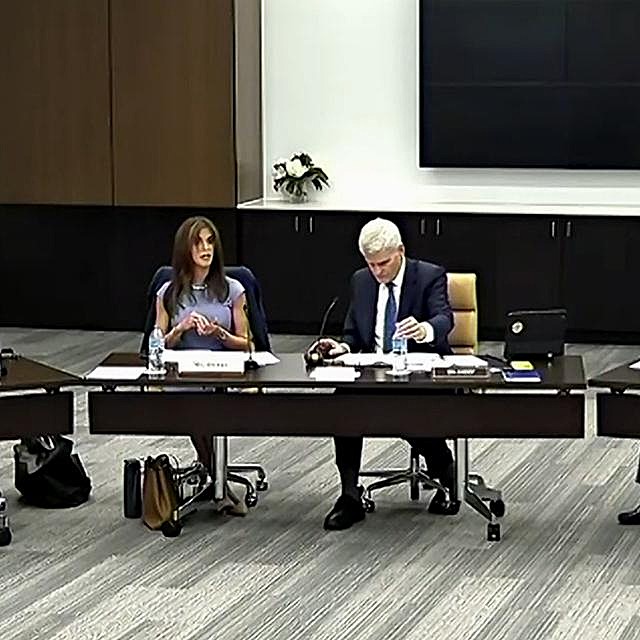
 Kathy Oubre, chief executive officer at Pontchartrain Cancer Center, appears at a Senate Health, Education, Labor and Pensions Committee field hearing in Baton Rouge, Louisiana. Credit: Senate HELP
The head of Lousiana health care delivery organization talked to a key senator Tuesday about how both health insurance premiums and health insurance out-of-pocket costs are reaching levels that are starting to push care out of reach even for some of the insurance companies' own employees.
Kathy Oubre, the chief executive officer of the Pontchartrain Cancer Center in Covington, Louisiana, appeared at the first of two field hearings that the Senate Health, Education, Labor & Pensions Committee is holding in Louisiana this week.
Sen. Bill Cassidy, R-La., the committee chair and a medical doctor himself, said he brought the committee to his home state to promote efforts to hold down the cost of health care and health insurance.
Oubre said in her formal testimony that health insurers and big, hospital-led health care systems are making cancer more expensive by buying independent cancer care centers increase service prices.
When hospitals centralize care in their own buildings, they may also move the sites of care to locations farther from where the patients live and work, Oubre said.
Oubre also talked about a 28-year-old actuary, or insurance math specialist, that she knows. The actuary works for a large insurance company, in a field that was not specified.
"He has a high-deductible plan," Oubre said. "He's functionally uninsured."
The young actuary is having trouble affording a medication he needs, Oubre added.
The young actuary knows another young actuary who was recently in an automobile accident and went to an in-network emergency room.
The friend "has to pay $4,000," Oubre said.
The friend can scrape together cash to pay the bill, but he is paying the bill by raiding the pot of cash he was going to use to buy a home, Oubre reported.
Coverage tradeoffs: Cassidy noted that the actuaries could have put money they saved by choosing high-deductible coverage into a health savings account or other savings account.
Ronnell Nolan, the CEO of Health Agents for America, a Baton Rouge, Louisiana-based group for health insurance agents and brokers, said the stories show why regulators and health insurers need to try to keep sales commissions and enrollment support fees high enough that agents, brokers and coverage counselors can help consumers understand the tradeoffs associated with their coverage choices.
"You either have a high deductible and a low premium, or a high premium and a low deductible," Nolan said.
Many young consumers feel invincible and do not necessarily understand how a high deductible would affect them if they had an unexpected injury or illness, Nolan said.
The cancer center's benefits bill: Oubre also talked about what health coverage now costs for a small employer that tries to hold down the employees' out-of-pocket costs.
The cancer center has 24 employees, and many are young women of childbearing age, she said.
Partly because maternity care is so costly, and partly because the cancer center offers a no-deductible, co-pay-only plan, the coverage now costs $1,700 per employee per month, or $20,400 per year, for employee-only coverage, Oubre said.
The backdrop: The testimony at the field hearing drew attention to the difficulty of holding down health care and health coverage costs by using higher out-of-pocket costs to give the plan participants "more skin in the game."
ADP recently reported that 26% of the U.S. workers it surveyed said worries about out-of-pocket costs kept them from getting care they needed in 2025.
Health care organization executives are saying that collecting payments from patients with high-deductible health coverage is often difficult or impossible.
© Arc, All Rights Reserved. Request academic re-use from www.copyright.com. All other uses, submit a request to TMSalesOperations@arc-network.com. For more information visit Asset & Logo Licensing.