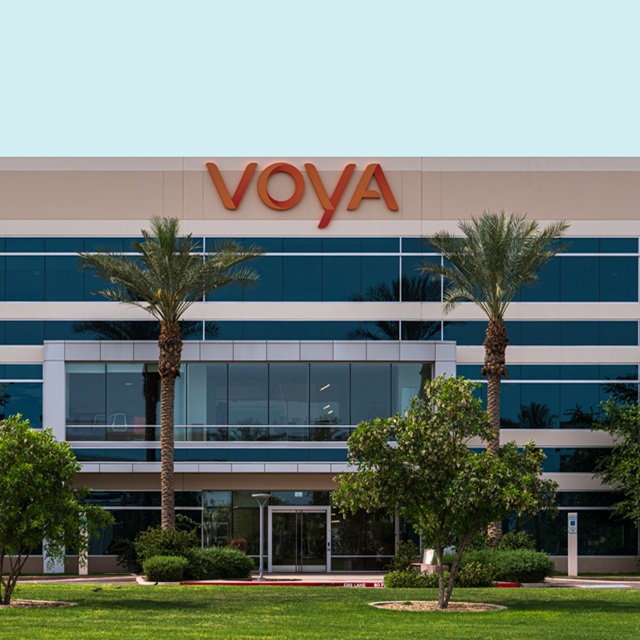
 Voya's offices in Chandler, Arizona. Credit: Rosemarie Mosteller/Adobe Stock
Executives at Voya Financial said Wednesday that the company's stop-loss insurance business is doing better, but they seemed to be open to hearing offers for that business and other company operations.
Voya talked about the possibility of making deals during a conference call the company held to go over earnings for the first quarter with securities analysts.
The company reported $195 million in net income for the quarter on $2 billion in revenue, up from $151 million in net income on $2 billion in revenue for the first quarter of 2025.
The company increased stop-loss prices an average of 24% for 2026, but sales increased 5.7%, to $280 million, and the estimated ratio of stop-loss claims to stop-loss revenue fell to 87%, down from 90% in 2025 and 89% in 2024.
"The pricing, underwriting and reserving actions we took last year have us firmly on the path to full margin recovery in this business," Heather Lavallee, Voya's chief executive officer, said during the analyst call. "We're not pivoting to growth. We continue with our focus on margin improvement in stop-loss and being very disciplined with pricing."
Voya streamed the conference call live online and posted a recording on its website.
Before the call, TOMS Capital Investment Management, an investment firm controlled by Noam Gottesman and Benjamin Pass, put out one press release saying that Voya has been too indecisive about its stop-loss business and encouraging parties interested in buying Voya's operations to "contact the board of directors directly." After the call, the firm put out another release urging "Voya's leaders" to "initiate a formal review of all strategic alternatives."
During the call, Andrew Kligerman, an analyst with TD Cowen, asked about the "activist investor's" push for "either divesting group stop-loss or putting the company up for sale."
Stop-loss earnings are improving, and Voya managers have demonstrated real value in improving the performance of the business, Lavallee said.
Lavallee seemed to acknowledge that Voya is considering a wide range of strategic options.
"At the end of the day, our actions and how we deploy capital are guided by what is in the best long-term interest of our shareholders, frankly, as well as our customers," she said. "And, as part of our normal governance with our board, we're constantly evaluating different strategic options that we can do, frankly, across the whole portfolio to drive shareholder value."
Another analyst, Thomas Gallagher, an analyst at Evercore ISI Institutional Equities, asked Voya executives: "Is it fair to say that you think stop-loss is a core part of the long-term Voya franchise? Or is that something you would consider divesting if the situation was attractive enough?"
Stop-loss "is very valuable for us in terms of earnings and cash generation," Lavallee said. "We see this as a valuable part of our portfolio... There's a lot of client demand, growing client demand, limited supply, hardening of the market and the ability to get the price. And we see this as continuing to be an earnings grower for the firm. So at the end of the day, stop-loss is one where it's going to be value creation for shareholders, as well as a strategic asset for Voya at the enterprise."
Lavellee appeared to emphasize the high value of the stop-loss business without saying whether Voya would or would not consider selling the business.
What it means: Employers that want better deals on stop-loss insurance may still have trouble getting stop-loss issuers to budge.
Stop-loss insurance: Employers with self-insured health plans use stop-loss insurance to protect the plans against catastrophic losses.
Large employers have been using the product for decades, and many smaller employers are now shifting to use of traditional self-insured plans and "level-funded plans," or self-insured plans with relatively low stop-loss limits, in recent years.
The backdrop: Stop-loss issuers reported low claim volume and high profits during and immediately after the COVID-19 pandemic.
The issuers began to talk about a surge in claims in mid-year 2024 and then emphasized moves to increase prices and tighten underwriting standards.
Some issuers seemed to see their stop-loss operations get back on track in late 2025.
Cigna reported an increase in stop-loss sales for the latest quarter but did not talk about claims.
Sun Life posted its own first-quarter earnings Wednesday. It reported strong stop-loss sales and a big improvement in claims.
John Thornton, an Amalgamated Life veteran, recently told ThinkAdvisor that he has seen some stop-loss issuers pulling back from the market but signs of overall market stability.
© Arc, All Rights Reserved. Request academic re-use from www.copyright.com. All other uses, submit a request to TMSalesOperations@arc-network.com. For more information visit Asset & Logo Licensing.