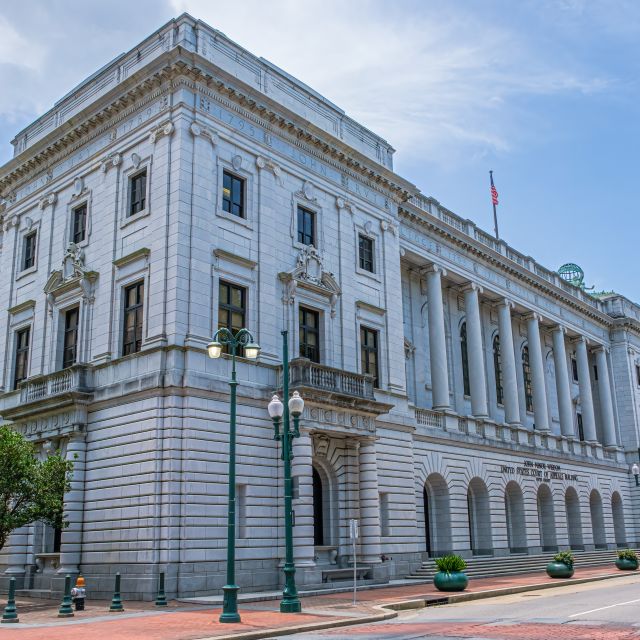
 The John Minor Wisdom U.S. Court of Appeals Building in New Orleans. Credit: John A. Morgan/Adobe Stock
Aetna has persuaded the 5th U.S. Circuit Court of Appeals to provide a full, "en banc" review for a case involving the arbitration clause in a health plan administration agreement.
Federal appeals courts rarely grant petitions for en banc rehearings. The new 5th Circuit decision means that all 17 judges who serve on the 5th Circuit will take a fresh look at a ruling that three of the judges issued in December 2025.
Aetna, a subsidiary of CVS Health, administered a self-insured health plan for Aramark, a big food service giant.
Aramark sued Aetna in a federal court in Texas in 2023 over what Aramark alleged were problems with how Aetna paid claims.
Aetna says a clause in a master services agreement for the Aramark plan requires Aramark to resolve the dispute through binding arbitration in Hartford, Connecticut. Aramark wants to keep the case in the federal court system.
What it means: The 5th Circuit's en banc rehearing of the case will give Aetna a new chance to move the dispute to the arbitration system.
Arbitration: Advocates for arbitration say it's a faster, cheaper system for resolving disputes that helps the federal courts cope with complicated, growing case loads.
Some parties in disputes believe they can get a better deal if they resolve their disputes in the federal courts.
Aetna-Aramark case details: Aetna began serving as the third-party administrator for Aramark's plan in 2018.
Aramark later argued that Aetna was approving too many improper claims.
The Aramark's master services agreement with Aetna requires Aramark to resolve disputes, other than requests for "temporary, preliminary, or permanent injunctive relief or any other form of equitable relief," through arbitration.
Aetna argued that Aramark was not seeking equitable relief because it was seeking cash payments, and a cash payment is not a form of equitable relief.
Two of the three judges on the 5th Circuit panel that ruled on the case in December 2025 held that Aramark could take the dispute to court, because a dispute over whether a matter must be arbitrated should be resolved by a court.
A third judge agreed that disputes over whether a case must be arbitrated should be decided by a court, but she argued that part of the ruling issued in December 2025 indicated that a request for money damages could be classified as a request for equitable relief.
The third judge objected to the idea of letting a request for money damages be treated as a request for equitable relief.
Peter Sessions, an ERISA law expert at Kantor & Kantor, wrote in a blog article about the ruling that it's not clear why the 5th Circuit decided to rehear the case en banc, but he speculated that the 5th Circuit might be interested in the definition of equitable relief.
En banc rehearings: The U.S. Courts of Appeals system includes courts for regional circuits and for a federal circuit.
The regional circuits received petitions for 2,959 en banc rehearings in 2025, according to official federal court statistics.
Firm figures are hard to find, but numbers posted by some circuits suggest that the regional courts may grant fewer than 150 petitions for en banc rehearings per year.
The 5th Circuit issues about 2,400 opinions per year and grants fewer than about a dozen petitions for en banc rehearings per year, according to the Take the Fifth blog.
© Arc, All Rights Reserved. Request academic re-use from www.copyright.com. All other uses, submit a request to TMSalesOperations@arc-network.com. For more information visit Asset & Logo Licensing.