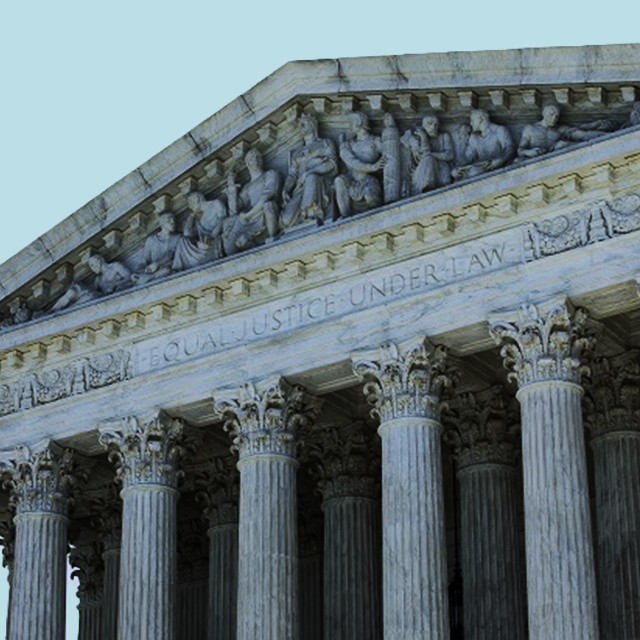
 The West Pediment of the U.S. Supreme Court. Photo: Diego M. Radzinschi/TouchPoint Markets
The U.S. Supreme Court handed down a unanimous ruling Thursday that could help increase the number of generic drugs available in the United States.
The court ruled in favor of Hikma Pharmaceuticals, a company that wants to sell a generic version of Vascepa, a brand-name drug from Amarin Pharmaceuticals, using a "skinny label" government drug approval label.
The active ingredient in Vascepa is icosapent ethyl.
The Supreme Court sided with Hikma, concluding that Amarin had not "plausibly alleged that Hikma actively encouraged infringing use," according to an opinion for the court written by Justice Ketanji Brown Jackson.
What it means: James Gelfand, the president of the ERISA Industry Committee, a group for the large, employer-sponsored benefit plans governed by the Employee Retirement Income Security Act, called the Hikma decision "a victory for every American worker and employer who relies on access to affordable prescription drugs."
The new skinny label ruling "ensures that a single indication-specific patent cannot be weaponized to block lower-cost generics from reaching the patients who need them," Gelfand said.
Drug patent basics: The average cost of developing a new drug is about $2.3 billion, according to Deloitte.
The U.S. patent system is supposed to encourage drug developers and other inventers to invent useful new items and processes by giving them exclusive rights to profit from the sale of their inventions for a limited period. The usual "market exclusivity" period created by a U.S. drug patent is 20 years.
Manufacturers of brand-name drugs argue that they need to charge high prices to offset the enormous cost of developing new drugs and cope with the relatively short duration of the patents.
Critics argue that the manufacturers of the brand-name drugs use their temporary monopolies to extort money from sick people and, in many cases, end up profiting from basic research that originally was done by scientists who used government money to fund their work.
Critics have also accused the manufacturers of brand-name dugs of using aggressive strategies to shut out would-be manufacturers of generic versions of the brand-name drugs and keep patent protection in place longer than 20 years.
The skinny label strategy: When the maker of a brand-name drug applies for a patent, it lists the conditions that the drug treats.
For about 40 years, the Food and Drug Administration has let a generic drug manufacturer get around the brand-name maker's patent by seeking FDA approval for a generic drug with a label that lists only conditions not inlcuded in the patent application for the brand-name version of the drug.
Manufacturers of brand-name drugs have sued to block the skinny label FDA applications, arguing that the skinny drug labels and the generic drug manufacturers' sales materials amount to "induced infringement" of the brand-name drug manufacturers' patent rights.
Hikma and Amarin: Amarin received one patent for use of Vascepa to treat severe "hypertriglyceridemia," or high blood levels of a substance that can cause clogged arteries, liver problems and gout. Amarin also received a second patent for use of Vascepa to treat cardiovascular risk in hypertriglyceridemia patients who already take statins.
In 2016, after Amarin's patent on use of its drug to treat severe hypertriglyceridemia expired, Hikma obtained FDA approval for a generic version of the drug using a "skinny label" that mentioned that the drug treats high triglyceride levels but not that it eases cardiovascular disease risk in people who have high triglyceride levels.
Amarin sued, arguing that the skinny label application strategy amounted to "induced infringement" of Amarin's right to market Vascepa as a drug that can reduce cardiovascular disease risk.
A judge at a U.S. District Court sided with Hikma. A panel at the U.S. Court of Appeals for the Federal Circuit overturned the district court's ruling.
The Supreme Court has now reversed the appeals court ruling.
Doctors understood that Hikma's version of the drug could protect people with high triglycerides from heart disease, but Hikma did not take the kind of active steps necessary to create induced infrigement, Jackson wrote in the opinion for the court.
"Amarin fails to allege 'more than a sheer possibility' that Hikma actively induced infringement," Jackson wrote in opinion. "Amarin's allegations, whether viewed together or separately, fail to establish that Hikma took any affirmative steps to encourage infringement."
Representatives for Amarin could not immediately be reached for comment. Hikma welcomed the ruling, saying it will help ensure that patients have ongoing access to generic drugs.
© Arc, All Rights Reserved. Request academic re-use from www.copyright.com. All other uses, submit a request to TMSalesOperations@arc-network.com. For more information visit Asset & Logo Licensing.