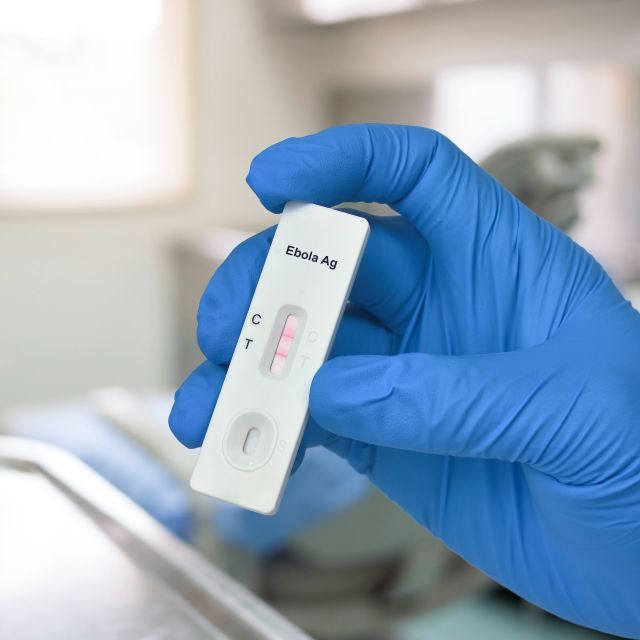
 A positive Ebola test. Credit: BLKstudio/Adobe Stock
The kinds of human resources executives, employee benefits managers and benefits advisors who think about hurricanes, wildfires and influenza outbreaks should be starting to think about Ebola.
That's the advice of Dr. Lorna Friedman, the global health leader for the multinational client segment at Mercer.
Friedman tends to work with the kinds of employers that might have offices in Chicago, London and Taipei, and executives who have obtained frequent-flyer levels beyond the understanding of ordinary mortals.
But Friedman said in a recent interview, via email, that she thinks any U.S. employer that does some kind of long-range planning should give Ebola some attention.
"An ounce of prevention is worth a pound of chaos," Friedman said.
The backdrop: The COVID-19 pandemic sputtered out around 2023.
Even for healthy workers infected before doctors knew what to do about it, Ebola likely had a mortality rate of less than 1 in 1,000.
The current Bundibugyo type of Ebola virus how affecting people in the Democratic Republic of the Congo and Uganda appears to be killing more than 20% of the people known to be infected. As of June 7, it had caused 569 confirmed infections and 120 confirmed deaths. Angry people have gotten people believed to be infected with the virus out of health care facilities and may have mixed them in with the general population.
Public health specialists with the U.S. Centers for Disease Control and Prevention, have predicted that, assuming communities continue to have trouble isolating people with the Ebola virus, there's a 65% likelihood that the number of cases could exceed 20,000 within three months.
If communities can put 70% of the patients in isolation, the odds that the numbe of cases will exceed 10,000 could be just 5%.
One question is whether it's possible for some patients carrying the virus to somehow travel outside the region. Some press reports have suggested that the virus may spread more easily than typical types of Ebola because the early symptoms are less severe.
Friedman's recommendations: Since the COVID-19 pandemic sputtered out, around 2023, employers have put planning for infectious disease risk relatively low on the priority list.
Top executives are worrying about artificial intelligence. Corporate risk managers are focusing on cyberattacks and geopolitical conflict. Benefits manages are wrestling with the high cost of the new weight-loss drugs, high specialty drug costs and strategies for cutting overall benefits costs.
The lack of attention now given to infectious disease risk may be under standandable, but "understanding where your potential vulnerabilities lie is critical," Friedman said.
Companies need to think about Ebola could affect their supply chains and ability to travel, and benefits and HR teams need to think about what a severe infectious disease outbreak that comes to the regions where they operate could affect employees' access to health care services, she added.
One thing Mercer and its clients learned from the COVID pandemic is that pandemic-related travel restrictions can affect travel far away from the places with cases of the disease of concern, and any pandemic-related strain on health care systems can cause huge problems for people who do not have the disease of concern but do have broken legs, Friedman said.
Benefits advisors and other advisors can help by using risk-evaluation tools and scenario-planning tools to help corporate clients think about Eboloa along with the many other hazards that could affect their operations and their employees, she said.
© Arc, All Rights Reserved. Request academic re-use from www.copyright.com. All other uses, submit a request to TMSalesOperations@arc-network.com. For more information visit Asset & Logo Licensing.