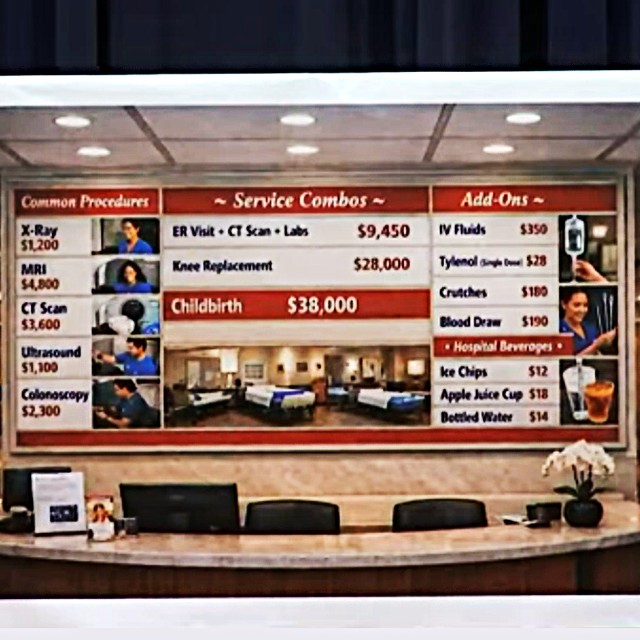
 Rep. Aaron Bean's hospital price menu proposal. Credit: House Ways & Means Committee
Republicans and Democrats on the House Energy & Commerce Health Subcommittee joined Thursday to approve a total of 15 health care bills by voice votes.
The Lower Costs, More Transparency Act of 2026, the Premium Transparency Act, the Prior Authorization Accountability Act and the Prices on the Wall Act of 2026 are approved bills that could directly affect employer-sponsored health plans.
The Lower Costs, More Transparency bill was introduced by Rep. Brett Guthrie, R-Ky., who also put a tougher, more standardized version of the current federal hospital price posting rules into federal law.
The Premium Transparency Act bill was introduced by Rep. August Pfluger, R-Texas, and would require issuers of fully insured group health insurance and other "payers" to release detailed overhead cost information.
The Prior Authorization Accountability Act bill was introduced by Rep. Craig Goldman, R-Texas, would require both health insurers and self-insured employer health plans to post detailed information about the operations of any prior authorization programs they use to manage use of care.
The Prices on the Wall Act bill was introduced by Rep. Mariannette Miller-Meeks, R-Iowa, and would require a hospital to post the discounted cash price, or median self-pay price for individuals, for shoppable services on its walls.
The committee streamed the "markup," or bill consideration meeting, online and posted a recording of the markup video on the web.
What it meetings: The House could pass major health care price and health plan operations disclosure legislation.
The backdrop: When the current congress, the 119th Congress, started up, in January 2025, the House Energy & Commerce Health Subcommittee appeared to be a refuge for some of the last embers of bipartisanship in the House.
Democrats on the committee asked about the fate of the subcommittee's work. Rep. Brett Guthrie, R-Ky., the chairman of the full committee, maintained that the subcommittee's projects were still alive.
The markup: Much of the health care cost discussion at the markup focused on the difficulty patients have with understanding what hospitals charge for care.
Some lawmakers talked about the impact of hospital cost confusion on their own lives.
Rep. Nanette Diaz Barragán, D-Calif., said she recently ended up in the hospital.
"I was actually told that, if I paid in advance, I would get a discount, and I was given an amount, so I paid that amount," Barragán said at the hearing. "Well, guess what? I went home, and I got a bill. I still got a bill, and I'm not the only one."
Some Republicans on the committee called for imposing much tougher, more detailed price disclosure rules on hospitals at the point of care delivery.
"Consumers deserve the same transparency that exists in virtually every other sector of our economy," Miller-Meeks, who is an eye doctor, said during a discussion about her Prices on the Wall bill. "Price transparency empowers patients. It encourages competition. It rewards providers who deliver the highest quality care at the most affordable cost, and it helps families make informed decisions about where they seek care."
Rep. Frank Pallone, D-N.J., said he agreed with the intent of the Prices on the Wall bill but believed that the results might be confusing and scare patients away from getting care that would be covered by their insurance.
"The prices that will be posted on the wall are not actually the prices that most patients would actually pay for those services," Pallone said.
But the Prices on the Wall bill then passed by a voice vote, with no nays from Pallone or authors audible on the House Energy video of the markup.
© Arc, All Rights Reserved. Request academic re-use from www.copyright.com. All other uses, submit a request to TMSalesOperations@arc-network.com. For more information visit Asset & Logo Licensing.