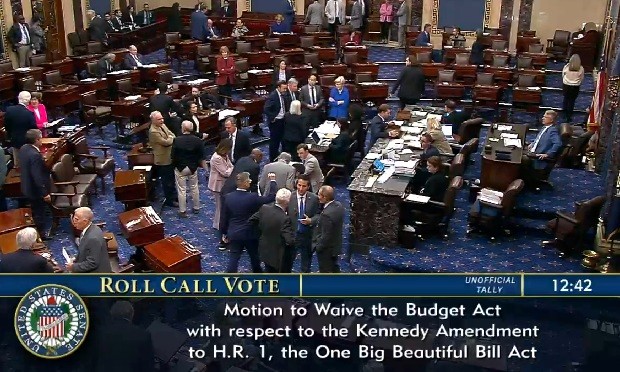
 Senators vote July 1 on a measure related to consideration of the One Big Beautiful Bill Act tax package. Credit: Senate
The health care real estate market may experience significant impacts from the recently enacted One Big Beautiful Bill (OBBB), which extends 2017 tax cuts and slows government spending, according to a CBRE analysis.
In particular, government-funded health insurance programs, including Medicaid and the Affordable Care Act (ACA) marketplace, could face stricter qualifications under the legislation that may increase demand for medical outpatient buildings (MOBs) and ambulatory surgical centers (ASCs) due to fewer inpatient-only restrictions for medical treatment and procedures, according to the analysis. This could accelerate a longer-term trend toward the necessity of lower-cost health care delivery solutions as more than $1 trillion in spending reductions are forecasted.
In addition, hospitals and health care systems that rely on government-funded programs may prioritize portfolio rationalization efforts, including consolidation, asset monetization and sale-leasebacks to achieve cost savings and better space utilization. Rural hospitals and community health centers, which are scheduled to receive $50 billion in additional funding over the next five years, may be disproportionately impacted by the OBBB spending cuts, said CBRE.
The analysis also said Medicaid enrollment could fall by 0.7% each year through 2034 as stricter eligibility requirements for adults roll out. Provider taxes, which states have historically used to partially fund their share of Medicaid, are projected to be reduced to 3.5% of net patient revenue over several years, down from 6%, and new or increased provider taxes cannot be enacted.
“Hospitals and health care providers that are more reliant on revenues from Medicaid may require greater scrutiny of their real estate footprints to achieve better space utilization and cost savings,” CBRE said.
“More consolidation and M&A activity among hospitals and health care systems may result from the loss of Medicaid revenue. This may give rise to opportunities for asset monetization and sale-leasebacks of property as some hospitals and health care systems seek greater efficiencies.”
In addition, enhanced federal tax credits that lowered the cost of ACA marketplace insurance plans during the pandemic will expire at the end of this year. The Congressional Budget Office estimates that this, plus stricter eligibility and income verification requirements, could cause 4 million people to become uninsured due to higher premiums.
The actual outcomes of the OBBB may vary significantly from expectations based on how states react to the provisions. Some may raise their own spending to backfill lost federal funds, which may reduce the number of people who become uninsured. The report noted a 19% drop in Medicaid enrollment between April 2023 and April 2025 due to the lapse of pandemic-era continuous coverage protections that did not result in significant impacts to health care providers.
“Many OBBB provisions are subject to revision and government guidance. Flexibility in planning and scenario modeling will be essential to navigate an evolving regulatory environment.”
© Arc, All Rights Reserved. Request academic re-use from www.copyright.com. All other uses, submit a request to TMSalesOperations@arc-network.com. For more information visit Asset & Logo Licensing.