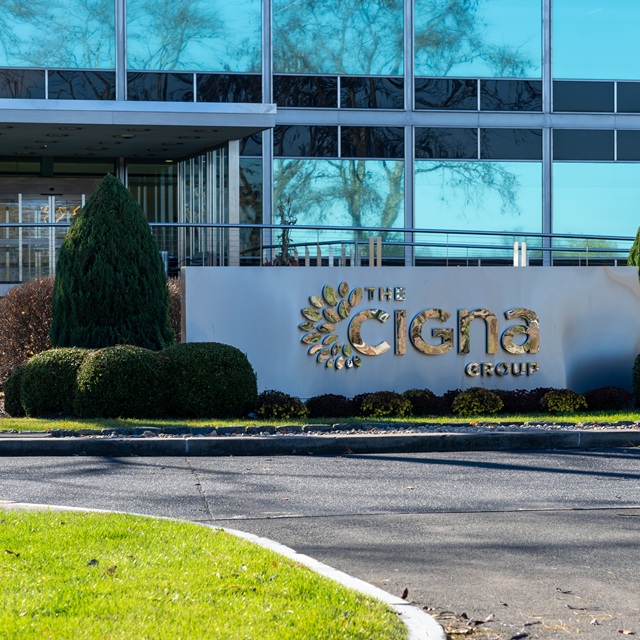
 Cigna's headquarters in Bloomfield, Connecticut. Credit: JHVEPhoto
Cigna Group’s pledge to upend the way medicine is priced spooked Wall Street after the company warned the move would hurt profits in the next two years.
The company’s shares closed down 17% Thursday, their worst one-day drop since 2008, after Cigna executives warned of the margin pressure during an otherwise routine earnings call. It’s evidence that the company’s plan to eliminate many drug rebates — opaque payments that fueled years of attacks on Cigna and its peers — will hit its bottom line.
“This is a fundamental business model pivot,” Chief Operating Officer Brian Evanko said on a call with analysts Thursday.
The move, along with concessions to its largest pharmacy benefit clients that will further compress profits, was intended to “future proof” the business, Chief Executive Officer David Cordani said.
This took Wall Street by surprise, turning early stock gains before the profit warning into a historic selloff, a decline RBC Capital Markets analysts described as “overdone.”
Drug prices, long a source of controversy in the US, are under renewed scrutiny as President Donald Trump pressures manufacturers to lower costs in the US while raising the prices abroad. Drug manufacturers are testing new ways to sell some medications directly to patients, circumventing the middlemen they’ve long accused of blocking access and driving up costs.
Cigna still expects earnings per share to grow in 2026, Cordani said. Other parts of its business, including medical plans and its specialty pharmacy, are expected to perform well.
Eli Lilly & Co. CEO Dave Ricks praised Cigna’s decision during the drugmakers’ earnings call Thursday.
“It’s a good move for patients. It’s a good move for payers, for the commercial payers. And probably smart of Cigna to make this first move,” Ricks said. “We hope others follow.”
For Cigna’s pharmacy benefits segment, which accounts for about 30% of operating profit, profit is set to decline next year, dragging down overall results.
The pressure on profits comes from two sources: Cigna has renewed pharmacy benefit contracts with three big clients — the US Department of Defense, Prime Therapeutics and Centene Corp. — through the end of the decade. Those deals will have different margins going forward.
The company is also making investments in the new pharmacy benefits model intended to eliminate drug rebates in many plans.
Cigna announced this week moves to shift away from using rebates in its Express Scripts pharmacy benefits business, the nation’s largest. The change to negotiate up-front discounts with drugmakers, rather than rebates collected long after a prescription is filled, is intended to lower patients’ costs at the pharmacy counter, the company said. It has the potential to upend how billions of dollars flow among drug companies, insurers and employers.
Transition costs
The new model is intended to insulate patients from high costs and support pharmacies with better reimbursements when they dispense drugs. It’s also squarely aimed at neutralizing longstanding complaints about the pharmacy benefits manager business model that have fueled lawsuits, Congressional investigations and bitter lobbying fights in Washington.
Drugmakers say PBMs don’t fully pass on the benefits of rebates to patients. Some employers argue the payments create conflicts for PBMs, who collect money from the pharma companies they negotiate with. And policymakers have taken aim at the rebate system.
“Our new rebate-free pharmacy benefit model will incur short-term investment and transition costs,” Evanko said on the call.
After those changes, though, the company expects earnings in its PBM to be comparable to what they are in the existing setup.
“I think that’s a very optimistic perspective,” said Adam Fein, president of industry researcher Drug Channels Institute, who is a frequent critic of PBMs.
“There’s a lot of margin that’s been hidden in the difference between gross to net price” of prescription drugs, he said in an interview.
Earnings beat
Before executives warned about the PBM margins, Cigna had a routine report on earnings in the third quarter. Profit topped Wall Street expectations, driven by growth in the company’s pharmacy and health services unit.
The health conglomerate reported adjusted earnings of $7.83 a share, above the average of analyst estimates compiled by Bloomberg. Adjusted profit for the year will be at least $29.60 a share, the company said in a statement Thursday.
Cigna, whose business focuses on pharmacy benefits and private insurance, has been relatively insulated from the turmoil in government health programs that upended the industry this year. The company recently sold its Medicare business and has avoided cutting its profit forecast like some of its largest rivals.
Medical costs in the quarter were more favorable than what analysts in a Bloomberg survey had forecast. Revenue grew about 10% from a year ago, powered by the company’s prescription drug plans, specialty pharmacy and related services in its Evernorth unit. Adjusted income from operations was down slightly due to lower profits in the company’s medical plans.
Copyright 2025 Bloomberg. All rights reserved. This material may not be published, broadcast, rewritten, or redistributed.
© Arc, All Rights Reserved. Request academic re-use from www.copyright.com. All other uses, submit a request to TMSalesOperations@arc-network.com. For more information visit Asset & Logo Licensing.