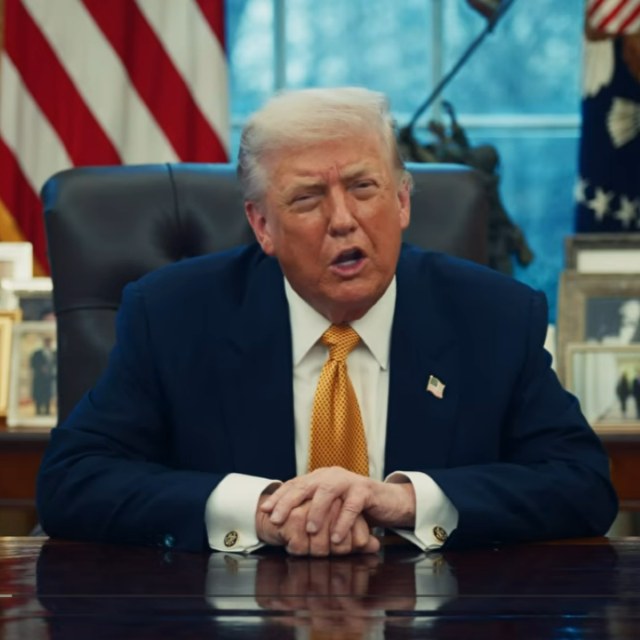
 President Trump discussed his health care framework proposal in a video shot in the Oval Office and posted Thursday. Credit: White House
President Donald Trump said Thursday that changing how pharmacy benefit managers pay other health benefits sector players will be part of his new Great Healthcare Plan.
"My plan ends the giant kickbacks to insurance brokers and corporate middlemen that only drive up the costs," Trump said during a speech about the plan that was delivered in the Oval Office.
The White House streamed the speech live online, posted a video of the speech on its website and also posted a fact sheet about the proposal.
The president did not give more details about his views on PBMs and their relationship with insurance brokers during the speech or in the fact sheet, and the thinking behind the accusation was not immediately clear.
The president may have been referring to concerns by people like Rich Westermayer of BeneSmart who contend that PBMs and other vendors may pay referral fees to brokers that influence the brokers' vendor recommendations.
The White House could not immediately be reached for comment.
The president's framework also calls for:
◆ Replacing any current federal programs that send subsidy payments to health insurance companies with programs that send subsidy payments directly to consumers.
◆ Funding the Affordable Care Act cost-sharing reduction program, which is supposed to reduce the impact of deductibles, coinsurance bills and copayment requirements on low-income people who buy individual or family coverage through the ACA public exchange system.
◆ Requiring health insurers to publish rate and coverage comparisons written in English.
◆ Requiring health insurers to post information about how much of their revenue they use to pay claims, their claim denial rates, the percentage of their claim denials that are eventually overturned on appeal, and how long their plan enrollees must wait to get routine care.
◆ Requiring hospitals that take Medicaid or Medicare to post detailed price information on their walls.
◆ Classifying more common, safe prescription drugs as over-the-counter drugs.
Trump's thinking: The president predicted that funding the ACA cost-sharing reduction program would cut ACA exchange plan premiums by about 10% to 15% and cut federal spending by at least $36 billion.
He called the current subsidy payment strategy a "flagrant scam," and he criticized "Obamacare" — the commercial health insurance framework created by the Affordable Care Act.
"Obamacare was designed to make the insurance companies rich," Trump said. "I call it the 'Unaffordable Care Act,' with billions of dollars in taxpayer subsidies that helped their stock prices skyrocket over 1,700%."
The president said replacing subsidies sent to health insurers with subsidies sent to consumers would help consumers buy their own health care.
"You'll make a great deal," Trump said. "You get better health care for less money. The big insurance companies lose, and the people of our country win."
The backdrop: The new White House framework proposal appears to reflect current Trump administration price transparency and PBM oversight efforts.
The proposal also reflects decades-long Republican efforts to prefer programs that provide cash payments for consumers over programs that send cash to doctors, hospitals, government programs or private insurance companies.
The proposal came out on the last day of the open enrollment period for ACA coverage for 2026.
Many people who use the ACA exchange system will be paying much more out of their own pockets for health coverage, because Congress has not agreed to extend a temporary subsidy boost provided in response to the COVID-19 pandemic. The subsidy boost expired Dec. 31, 2025, and created an especially steep "subsidy cliff" for exchange plan users with income over 400% of the federal poverty level. Some have said their families' coverage costs could increase to about $50,000 this year, from less than $7,000 in 2025.
Reactions: Chris Bond, a representative for America's Health Insurance Plans, a group for health insurers, said health plans welcome ideas for bringing down the prices that drug manufacturers charge and for empowering consumers to make the best health care decisions for themselves and their families.
The National Association of Business and Insurance Professionals said via email that it's reviewing the framework proposal.
The proposal "appears focused on lowering costs through greater transparency, especially in the prescription drug supply chain and PBM practices," the group said. "NABIP has consistently called for stronger PBM accountability and transparency in our comment letters and press statements because those opaque pricing practices can drive higher premiums and out-of-pocket costs for consumers. At the same time, NABIP strongly opposes any effort to lump licensed agents and brokers into 'middlemen' rhetoric. Our comment letters and press releases have repeatedly made clear: Agents and brokers are frontline consumer advocates who help Americans understand their options, enroll correctly, and keep coverage year-round — at no additional cost to the consumer."
Rep. Diana DeGette, D-Colo., the highest-ranking Democrat on the House Energy and Commerce Committee's health subcommittee, called the president's proposal "a feeble attempt to save face" after the expiration of the ACA subsidy boost.
Most of the framework "is just minor tweaks to existing policies which will not increase transparency nor meaningfully lower costs for the American people," she said.
Congress was close to approving a PBM oversight deal at the end of 2024, but the president and Elon Musk killed the PBM deal, DeGette added.
© Arc, All Rights Reserved. Request academic re-use from www.copyright.com. All other uses, submit a request to TMSalesOperations@arc-network.com. For more information visit Asset & Logo Licensing.