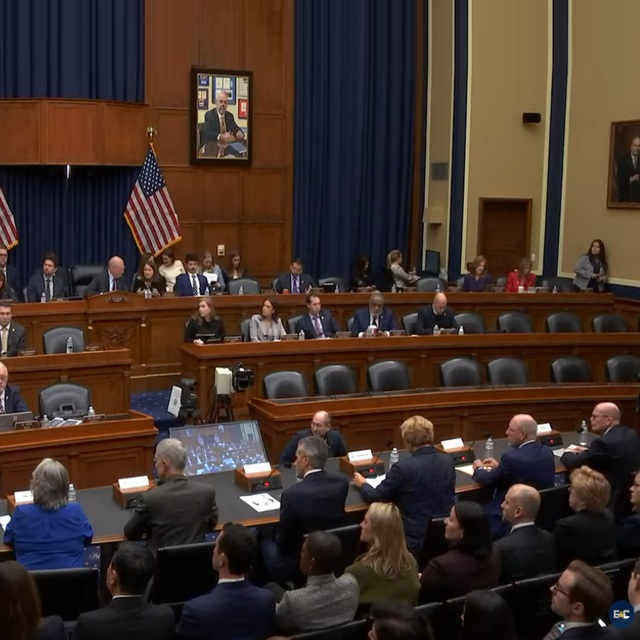
 House committees brought health insurance company CEOs in for a hearing on health care costs Thursday. Credit: House Energy and Commerce Committee
The House Energy and Commerce Committee's health subcommittee hauled the chief executive officers of four giant health insurers in for a hearing today to ask them to explain the high cost of health care and health insurance.
Rep. Morgan Griffith, R-Va., the chairman of the subcommittee, looked hard at the CEOs — Stephen Hemsley of United Health, Gail Boudreaux of Elevance Health, David Cordani of Cigna and David Joyner of Aetna's parent, CVS Health — and told them that employers are losing the ability to offer the health benefits they need to attract talent.
"Each year, more American small businesses choose not to offer health insurance because it is too costly," Griffith said at the hearing, which was streamed live on the web as House members were debating a $1.2 trillion federal government spending package on the House floor. The spending package contains pharmacy benefit manager transparency provisions long sought by Griffith and others on the Griffith's subcommittee.
Both Democrats and Republicans blasted the CEOs over their companies' revenue, profits, executive compensation arrangements, and efforts to hold down overall health care spending by managing patients' use of care.
Rep. Debbie Dingell, D-Mich., told the CEOs that people she talks to can't afford inhalers for children with asthma. She said a CBS News analysis found that UnitedHealth had rejected one-third of in-network requests for preauthorization for care.
"Patients who are battling terminal illnesses are spending the last days and months of their lives with their loved ones on the phones battling with insurance companies," Dingell said, then asked Hemsley whether dying patients should have to spend hours fighting to get their treatments approved.
"It's very important that people not go through that kind of complexity," Hemsley said. He noted that only about 2% of procedures the company's plans cover are subject to prior authorization.
Rep. Buddy Carter, R-Ga., a pharmacist, followed Dingell and posted a picture of a woman who is fighting to avoid a recurrence of breast cancer and facing problems with persuading UnitedHealth to continue to cover the drugs that are being used to keep the cancer from coming back.
Carter told Hemsley that he, as a pharmacist, has had to look patients in the eye and tell them that their health plans won't cover the drugs that might keep them alive.
The seven biggest health insurers generated $10 trillion in revenue from 2014 through 2024 and reported $543 billion in profits, at a time when patients have accumulated $220 billion in medical debt.
"Premiums are rising, and patients struggle to afford care," Carter said. "The system is failing the people it's meant to serve."
The CEOs tried to stay calm in the face of the fury. Joyner, for example, noted that he had returned his bonus for 2024 to the CVS employee relief fund because of concerns about company performance.
UnitedHealth tried to ease lawmakers' concerns about the possibility that Affordable Care Act premium subsidies and coverage rules might be increasing coverage prices and profits by agreeing Wednesday to provide rebates of any profits it earns on ACA exchange plans in 2026 to the enrollees.
Hemsley tried to make the case at the hearing that insurers are some of the only players in the health care delivery and finance system who have an incentive to try to keep health care spending down.
"The cost of health care insurance fundamentally reflects the cost of health care itself," Hemsley said." It is more an effect than a cause."
The CEOs told lawmakers that policymakers could help by keeping providers from charging patients more for care delivered in some locations than at other locations; by increasing the ability of providers' and insurers' electronic health record systems to work together; and by encouraging expanded use of health savings accounts and high-deductible health plans by letting HSA-compatible HDHPs cover more services before patients reach their deductibles.
The CEOs also asked for help with keeping providers from using the new No Surprises Act provisions that are supposed to protect insured patients against big, out-of-network bills for certain types of care from gaming the system and driving up the cost of out-of-network care.
Hemsley suggested that setting standard broker compensation levels could help brokers do a better job recommending high-value coverage.
The House Energy health subcommittee posted a recording of the hearing on its website.
The House Ways and Means Committee was preparing to hold a similar health insurance company CEO hearing after press time.
House Budget Committee's hearing: The House Budget Committee held a hearing of its own on U.S. health care costs Wednesday.
Joel White, president of the Council for Affordable Health Coverage, promoted the association health plan concept, or efforts to help employers team up to buy health coverage.
White also called for more price transparency, efforts to break up monopolies, and supporting efforts by the administration of President Donald Trump to send subsidy money to consumers' health savings accounts rather than to insurance companies.
"Every plan offered should have an HSA sidecar, and families should keep the difference between the subsidy and the premium in that HSA," White said. "Redirecting money to people would fundamentally change market incentives and drive costs down."
Avik Roy, the chairman of the Foundation for Research on Equal Opportunity, repeated an argument that he and some other health economics watchers have been making for years: that the main reason U.S. health care costs are so high is the federal income tax exclusion for employer-sponsored health benefits.
Because of the exclusion, "employers and insurers have little incentive to control costs," Roy said. "We constantly demand that more services be covered by health insurance, in a way we would never demand of car insurance, because of the tax subsidy."
Roy said he would like to see the U.S. health care system emulate the system in Switzerland, where people get their own individual coverage from commercial insurers rather than through employers.
One good approach would be to improve the Affordable Care Act exchange plan market and encourage most people to move to the ACA exchange market, Roy said.
© Arc, All Rights Reserved. Request academic re-use from www.copyright.com. All other uses, submit a request to TMSalesOperations@arc-network.com. For more information visit Asset & Logo Licensing.