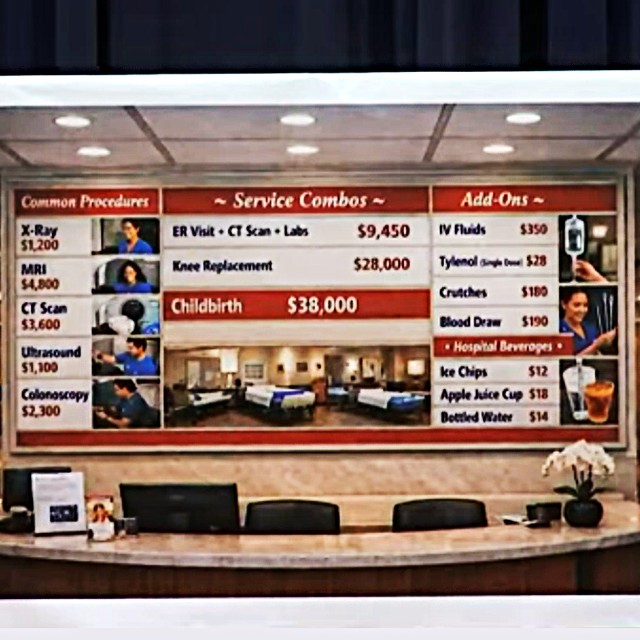
 Rep. Aaron Bean's hospital price menu proposal. Credit: House Ways & Means Committee
Some members of the House Ways & Means Committee are trying to keep low Medicare and Medicaid reimbursement rates from pushing up prices for employer-sponsored health plans and other commercial insurers.
Lawmakers talked about the cost-shifting problem Tuesday, at a committee hearing featuring the chief executive officers of "health systems," or organizations that own medical practices and clinics along with hospitals.
Some economists have argued that the biggest difference between the cost of health care in the United States and other rich countries is the high cost of hospital care, and some members of the committee pressed the hospital CEOs for explanations of why U.S. hospital services cost so much. One focus was the argument that costs have increased partly because of "vertical integration," or the fact that big health systems have acquired many medical practices and other vendors and suppliers of patients.
Sam Hazen, the CEO of HCA Healthcare, a giant hospital company, said hospital care costs what it does partly because the U.S. population is sicker and older, and partly because hospitals do a big, important, complicated job.
"Our hospitals operate 24 hours a day, 365 days a year," Hazen said. "They are designed to operate under extreme conditions and remain open and responsive throughout public health emergencies like the COVID-19 pandemic, hurricanes such as Hurricane Helen, and other disruptions. We provide critical life-saving services, and we care for every patient who comes through our emergency room doors, regardless of their ability to pay. Last year alone, we provided approximately $4.5 billion in uncompensated care."
Dr. Michael Waldrum, the CEO of ECU Health, a health system in eastern North Carolina, said his organization has acquired medical practices and other hospitals mainly because it operates in areas at risk of becoming of hospital deserts.
"The assumption that we are consolidating out of profit motive is wrong," Waldrum said. "I've never bought or sold a practice because any of the doctors or hospitals or communities wanted to actually make that happen. Our system grew because all eight rural hospitals were failing and about to be closed when they approached us."
Some of the committee members — including Rep. Aaron Bean, R-Fla.; Rep. Brian Fitzpatrick, R-Pa.; and Rep. Thomas Suozzi, R-N.Y. — noted that one of the pressures health systems face is the difficulty of breaking even on patients who come in with Medicaid, Medicare or no health insurance at all.
"You have to figure out how to make up for the losses you have in other areas by doing these other things," Suozzi said. "And some of the things that you do, I would suspect, are what has been referred to as 'gaming the system.' It's all perfectly legal, but you're trying to use existing laws that are incredibly complicated. You do something over here, and it pops out over there."
Suozzi asked the CEOs to work with him, Republicans on the Ways & Means Committee, and outside experts to come up with ways to make the situation better.
Bean said he believes that there is bipartisan support on the committee for making U.S. hospitals more affordable and the hospital market more competitive.
He made the case for increasing competition by increasing patients' ability to see hospital service costs in advance.
"But how do we have a competitive marketplace when the public does not know the prices?" Bean asked. "We've passed bills in the state of Florida. We've passed bills here. How do we get hospitals to be more transparent?"
Bean reported that he had no idea what his own knee replacement surgery would cost.
"I still don't know what it really cost," Bean said.
He presented a mock-up of what he thinks hospital price disclosure should look like: The equivalent of a fast-food restaurant price menu display hanging behind the hospital's front desk.
"The answer can't be, 'We need more subsidies,'" Bean said. "The American taxpayer is out. We can't do it anymore. So, what can we do?"
© Arc, All Rights Reserved. Request academic re-use from www.copyright.com. All other uses, submit a request to TMSalesOperations@arc-network.com. For more information visit Asset & Logo Licensing.