 Credit: Koonsiri/Adobe Stock
Retirement plans are often an unrecognized strategic workforce tool.
Current workforce trends, such as an aging labor force, extended working lives and the decline of defined benefit plans, make employer support for retirement an increasingly important business issue. As a result, plan sponsors have an opportunity to improve business results by leveraging their retirement plan strategy and understanding its impact on their workforce.
To do so, plan sponsors should consider the following when assessing their retirement plans:
◆ Retirement plans can support organizational success beyond their cost and risk.
◆ Plans affect employee attraction, retention and motivation.
◆ Plans offer the potential to impact business outcomes positively if they meet employee needs and help secure the workforce required to drive high performance and growth.
According to the Society of Actuaries Research Institute's report Understanding and Enhancing the Workforce Impact of Retirement Plans, actuaries and other benefits professionals can use a data-driven framework to assess how retirement plans impact the workforce and identify what changes are needed to support both business goals and employee needs.
The framework introduced in the report builds on traditional actuarial analysis, which primarily focuses on plan costs and liabilities, annual contributions and plan valuation for corporate financial results.
Retirement timing, internal labor markets and business operations
Employer retirement benefits affect an organization's workforce in three fundamental ways:
◆ Attracting talent.
◆ Motivating employees to stay and build tenure, experience, capabilities and careers.
◆ Encouraging timely employment exit via retirement, depending on corporate goals.
Data-driven analysis of retirement plan strategies is centered on the concept that each organization has its own "internal labor market." An internal labor market analysis measures and models hiring, exits, internal moves across roles and levels, along with associated rewards, to better understand how the workforce is evolving relative to business needs.
Organizations focused solely on headcount may be ignoring the need to retain skilled workers, leading to potential problems.
A classic story from early in my career involved a major telephone company that laid off most of the employees responsible for fixing phones.
This resulted in long delays for phone repairs due to the failure to identify the implications of downsizing workers with this particular skill.
As this example illustrates, more rigorous and fact-based analysis of human resources is a critical business issue.
Case studies: Alignment and misalignment
Using two hypothetical companies, ProfessionalCo and ConsumerCo, the following examples illustrate retirement plan strategies that take into account internal labor markets versus those that do not.
ProfessionalCo was a professional service company with a defined benefit plan that encouraged on-time retirement when the firm needed to retain experienced employees.
To address this, the company modified the plan to introduce a phased retirement program, allowing employees to collect some pension benefits with a reduced workload.
As a result, ProfessionalCo retained high-value senior professionals required for business success.
ConsumerCo built a strategy that relied on employees moving up or, in many cases, out of the organization. The company froze its defined benefit plan, delayed retirements and increased overtime.
The internal labor market map showed low velocity of talent movement and many bottlenecks, leading to long periods before promotion was possible and loss of high-potential talent.
The resulting workforce led to poor business results, indicating that the retirement plan was counterproductive to business needs.
Implementing a retirement assessment framework
The ConsumerCo and ProfessionalCo examples demonstrate how retirement plan designs can affect both an organization's workforce and its business strategy.
A framework that evaluates and designs retirement plans for an organization's unique context starts by asking questions that examine the link between business and workforce requirements.
The questions should cover these key business issues:
1. Business strategy.
2. Workforce requirements.
3. Talent shortages.
4. Workforce investments.
5. Value of tenure to business.
6. Build vs. buy workforce strategy.
7. Talent velocity and career bottlenecks.
8. Flexible work arrangements.
9. Retirement rates.
10. Reward philosophy.
Linking data to business strategy
Data and metrics create the engine that drives analysis.
The data needed includes information about the employee, their job progress, performance, pay and benefits.
The table below shows the data and metrics associated with two key business issues.
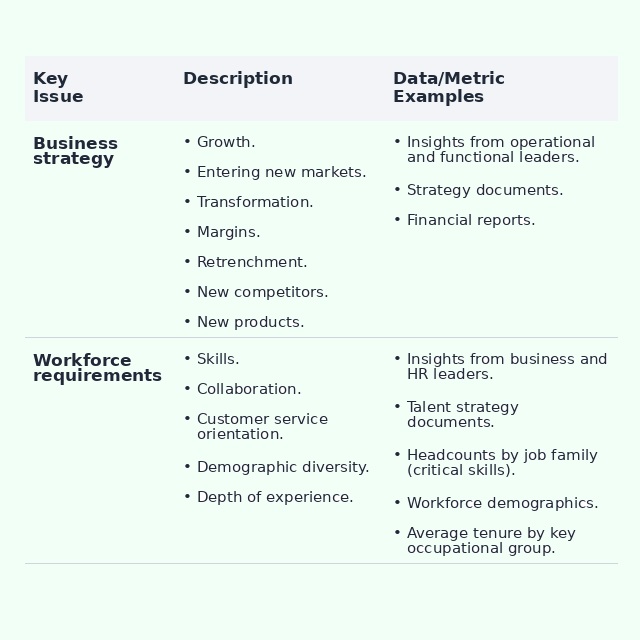
Most of this data resides in standard human resources information systems, or HRIS.
Using the results: From diagnostics to retirement strategy design
The changes to retirement plan strategies should consider both business factors and employee preferences.
In addition to considering the financial effect of a change on employees, sponsors should recognize that workers are likely to prefer some plan provisions over others.
Some design levers that can improve the effectiveness of retirement plan strategies and better align business goals with workforce preferences include:
◆ Early retirement windows.
◆ Phased retirement programs.
◆ Service rule changes.
◆ Lump-sum inducements.
◆ Reopening defined benefit plans.
◆ Enhancing annuitization options.
The expansion of flexible work options in recent years is now experiencing some retreat and uncertainty, with many age-friendly practices, such as phased retirement, still not widely accepted.
Workplace flexibility includes weekly schedules, workload and remote work.
A variation that may be useful is contract work, where the employee is hired to complete a specific project, possibly for a fixed price.
Another variation is use of a temporary pool that hires people to work on specific days.
Overall, changes in plan design and employment practices such as these can have an interactive impact that results in beneficial synergies.
Implications for retirement professionals
These frameworks bring together the traditional training of actuaries and retirement professionals with that of labor economists and organizational psychologists.
The data requirements for the framework typically exceed what is needed for traditional actuarial pricing and valuation analysis.
For example, data on all employees, not just those eligible for pension benefits, is part of the analysis. Other data sources, in addition to HRIS, may also be needed.
Effective analysis requires the participation of actuaries and other outside advisors along with senior leaders, HR analytics experts and other stakeholders.
The ever-evolving workplace makes it imperative for experts to break through silos and team up with colleagues across the organization.
Encouraging people to think outside their usual areas of focus may cause initial discomfort, but the potential payoff for the organization is worth addressing any hesitations.
The most important requirement to implement the framework successfully is shifting the traditional mindset for retirement plan management.
As discussed, retirement plan design aligned with other talent management practices can directly impact internal labor markets.
Therefore, in an age where the effectiveness of human capital management is a key source of competitive advantage, the workforce impact of retirement plans merits equal consideration with the evaluation of costs and risks.
Anna M.Rappaport, FSA, MAAA, started her own consulting firm after retiring from a career as a partner at Mercer. She is a past president of the Society of Actuaries and chairs its Committee on Post-Retirement Needs and Risks. She serves on the board of the Women's Institute for a Secure Retirement, or WISE, and served on the advisory board of the Pension Research Council.
© Arc, All Rights Reserved. Request academic re-use from www.copyright.com. All other uses, submit a request to TMSalesOperations@arc-network.com. For more information visit Asset & Logo Licensing.