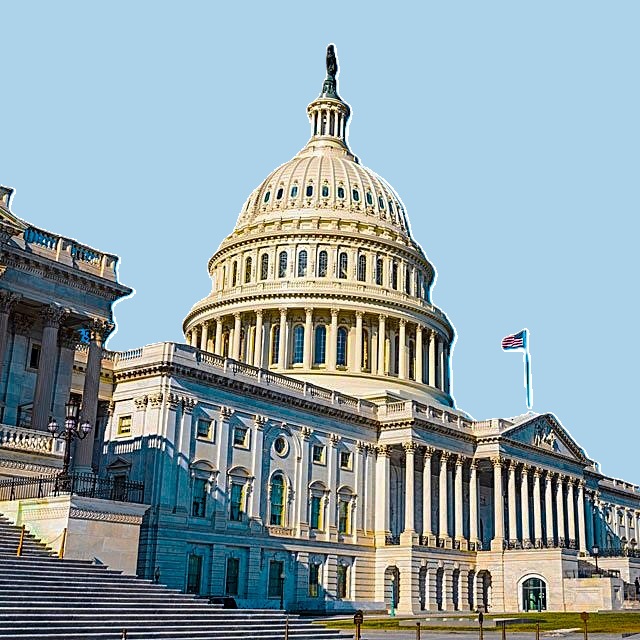
 The U.S. Capitol. Credit: Shutterstock
Conservative Republicans in the U.S. House are trying to get health savings account changes and an employer health coverage purchasing coalition provision into any big "Reconciliation 3.0" package that Congress considers.
Rep. Eric Burlison, R-Mo., held a press conference today in Washington to propose using his Great American Healthcare Plan bill as the vehicle for ferrying health benefits provisions into Reconciliation 3.0.
The plan "gets bureaucrats and middlemen out of the way," Burlison said during the press conference. "It puts Americans in control of their health care dollars."
The list of colleagues who are supporting Burlison's effort includes Reps. Mike Kennedy, R-Utah; Chip Roy, R-Texas; and Troy Downing, R-Mont.
Burlison has support from general-interest conservative groups, such as Americans for Tax Reform and the Heritage Foundation. He also has support from the Council for Affordable Health Coverage, the ERISA Industry Committee, the HSA Coalition and Health Equity.
Burlison's bill: Burlison's Great American Healthcare Plan bill is a collection of many different health system provisions.
The bill, which has seven Republican cosponsors and no Democratic cosponsors, would:
◆ Let employers satisfy Affordable Care Act "shared responsibility" coverage requirements by making contributions to employees' HSAs.
◆ Make it easier for employers to team up to buy health coverage, by classifying a "health marketplace pool" as an "employer" for purposes of offering group health plans or group health insurance coverage.
◆ Treat an unlimited amount of direct primary care dues as qualified medical expenses for HSA purposes. Today, the limit is $150 per month for an individual and $300 per month for a family.
◆ Provide the same bankruptcy protections for HSA assets as for retirement account assets.
◆ Let charities contribute to people's HSAs.
◆ Let people with HSAs use the account assets to pay for memberships in health care sharing ministries.
What it means: Congressional committees have been scheduling all of those health care cost and health insurance hearings in recent weeks for a reason.
Lawmakers think there's a chance a Reconciliation 3.0 package could include health care and health insurance provisions.
Reconciliation 3.0: Members of Congress usually need at least 60 votes to get ordinary bills through the Senate.
Supporters of bills related to federal spending can get those bills through the Senate using a special reconciliation process with just 51 votes.
Because reconciliation bills can move through the Senate relatively easy, they tend to become enormous packages that move many different kinds of spending-related bills through Congress.
The first reconciliation bill that President Donald Trump signed during his current term was the legislation that created the One Big Beautiful Bill Act, or OBBBA.
The second created the Secure America Act, a package that provided funding for the Immigration and Customs Enforcement and U.S. Customs and Border Protection agencies.
The Reconciliation 3.0 health care chatter: OBBBA started out with many health savings account provisions and other health account provisions, including one that would have put the rules supporting individual coverage health reimbursement arrangement plans, or ICHRA plans, in federal law.
In recent weeks, lawmakers have talked about using Reconciliation 3.0 to revive at least some of the health account provisions cut out of OBBBA.
Lawmakers have also talked about letting or requiring the high-deductible plans that are compatible with HSAs to cover more services before the enrollees meet their deductibles.
Pharmacists in Congress want to put new restrictions on pharmacy benefit managers in Reconciliation 3.0.
© Arc, All Rights Reserved. Request academic re-use from www.copyright.com. All other uses, submit a request to TMSalesOperations@arc-network.com. For more information visit Asset & Logo Licensing.