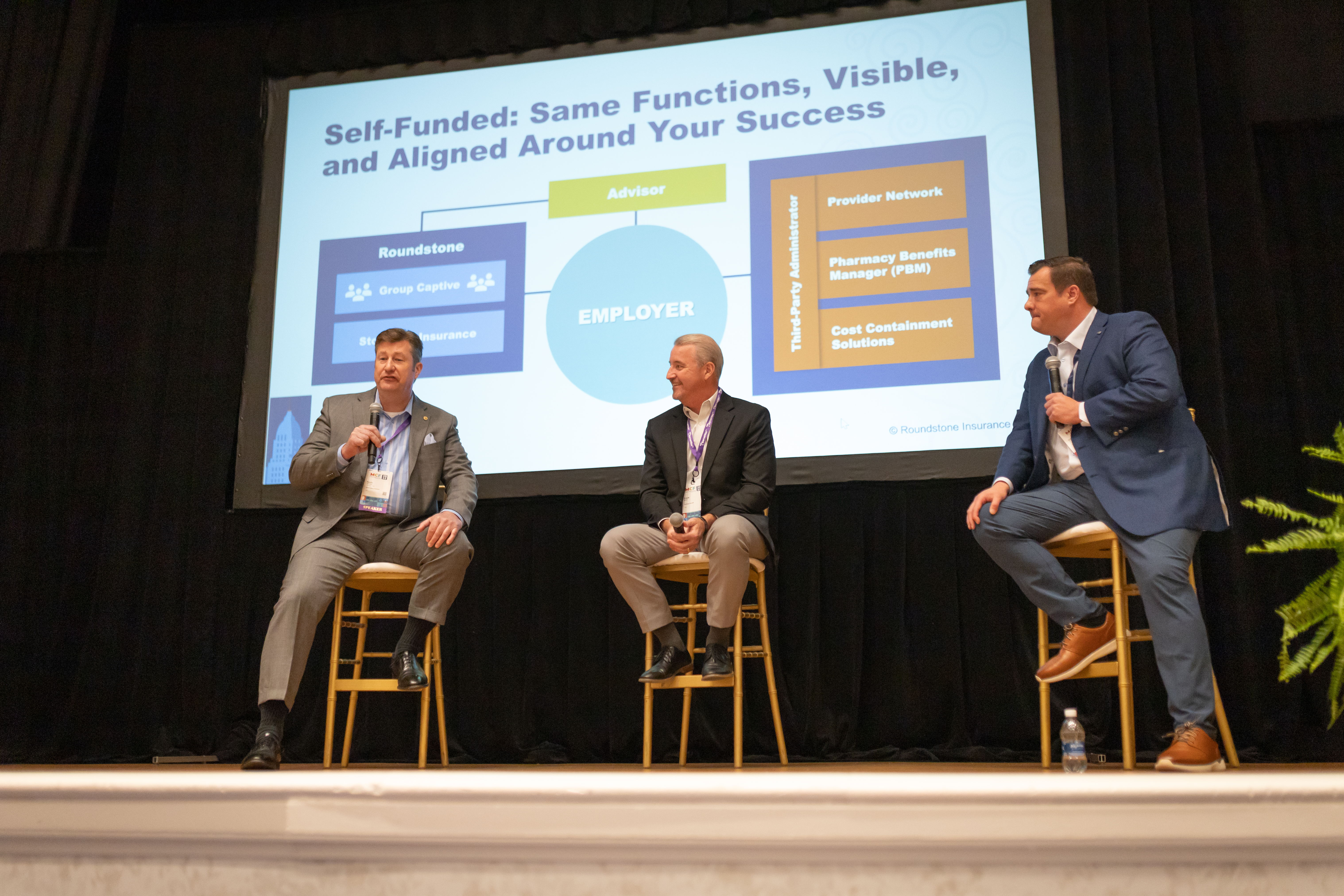
 Speakers discuss the advantages of self-funded insurance at Roundstone's 2025 Medical Captive Forum. With 75% of employer-sponsored health insurance projected to be covered by self-funding plans by 2030, benefits advisors need data and training to help guide clients through this switch.
Sixty-three percent of employees with employer-sponsored health insurance are covered by self-funded plans — a share that’s projected to reach 75% by 2030.
As small and mid-sized companies drive the movement from traditional fully-funded plans to self-funded, these organizations are looking for benefits advisors who understand how self-funding works, when it fits best and how to explain its advantages.
“The continued movement to self-funded plans gives advisors a better toolbox to assist clients in optimizing their health plan,” says Michael Schroeder, Founder and President at Roundstone Insurance. “With the transparency, control and cost savings available through self-funding, advisors become true consultants and advocates for their clients, rather than showing them three or four choices with traditional plans.”
Benefits advisors looking to transition into knowledgeable self-funded health plan consultants need to focus on three educational priorities: self-funding fundamentals, data-driven insights and high-impact training.
Understanding self-funding fundamentals
Effective self-funded plan consulting starts with mastering the core components that differentiate these arrangements from fully insured options. Self-funding requires understanding multiple moving parts, including the role of captives, stop-loss coverage, third-party administrators (TPAs), provider networks, and pharmacy benefit managers (PBMs).
“Essentially, advisors are unbundling the insurance transaction for their clients,” Schroeder explains. “With self-funding, the benefits are transparency and information, but it doesn’t help to move away from an opaque solution into one that's just slightly opaque.”
Schroeder recommends evaluating self-funded solutions based on access to information, as well as plan design flexibility and variable cost models that enable employer clients to retain the savings. The first step is identifying group medical captives that focus on education and end-to-end support for both advisors and employers.
Health Insurance Strategy Leading with data
The data available through self-funded plans creates opportunities for advisors to help clients compare plans, identify enhancements and benchmark cost savings.
“When educating employers about self-funding, we recommend that advisors use the per-employee-per-year (PEPY) cost to demonstrate value and pinpoint improvement areas,” says Beth Snyder, Chief Operating Officer at Roundstone. “It’s an effective way to compare fully-insured, level-funded and self-funded plans and track cost savings over time.”
While most companies track the PEPY healthcare spend, Roundstone’s CFO Leadership Survey reveals that only one in four fully understands and uses the metric. Advisors can make the PEPY a meaningful benchmark that identifies when clients are overspending and where targeted interventions make sense.
“There’s a misperception that self-funding is too complicated for employers,” Snyder says. “But when we see advisors lead with data, they’re able to educate their clients and provide added value.”
Building self-funding expertise
As group medical captives give small and mid-size businesses access to the advantages of self-funding through risk-sharing and negotiating leverage, advisors need to build a knowledge base to help clients who want answers to their questions.
"Because there’s been so much growth, if you're not talking about self-funding to your clients, somebody else will,” Snyder says.
As advisors build their knowledge, Snyder suggests working with partners like Roundstone that provide a range of education and support, including beginning, intermediate and advanced tracks, continuing education and certification programs, sales enablement tools and expert support for client meetings, proposals and renewals.
As self-funded health plans capture increasing market share, advisors who invest in understanding self-funding fundamentals, leading with data and building their expertise are positioned to deliver enhanced value to clients.
Roundstone is an innovative employee health benefits company helping small- and mid-size businesses deliver affordable, high-quality coverage. Learn more about Roundstone's self-funding resources here.
Ann Clifford is a freelance writer who translates her background in financial services marketing into specialized content focused on employee benefits and small business topics.
© Arc, All Rights Reserved. Request academic re-use from www.copyright.com. All other uses, submit a request to TMSalesOperations@arc-network.com. For more information visit Asset & Logo Licensing.